No products in the cart.


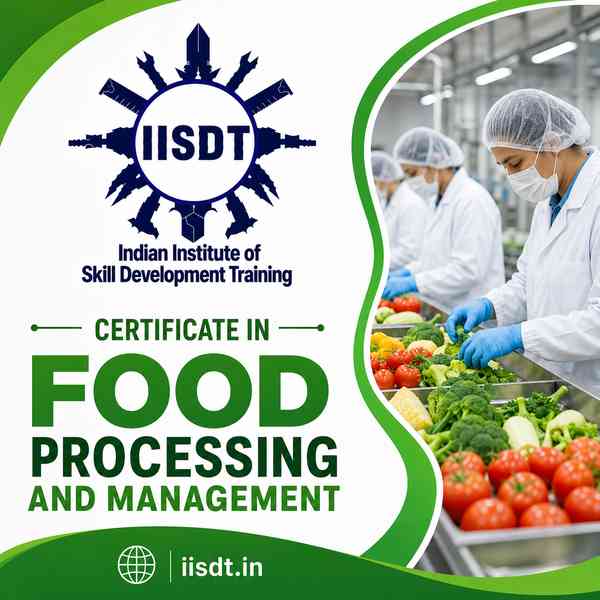
Certificate in Food Processing and Management
₹6,500.00 ₹3,250.00
50% fee concession will end in
Certificate in Food Processing and Management course is ideal for individuals looking to enter the food processing industry or those wishing to advance their careers within food technology, food safety, or food product management. It provides the essential knowledge needed to manage food production processes, ensure quality standards, and contribute to innovations in the food sector.
Description
Course Name: Certificate in Food Processing and Management
Course Id: CFPM/Q1001.
Eligibility: 10th Grade (High School) or Equivalent.
Objective: A Certificate in Food Processing and Management is a specialized program designed to equip individuals with knowledge of food processing techniques, industry standards, food safety regulations, and the management skills required to operate effectively within the food production sector. This course is ideal for those looking to start a career in food processing, food technology, or the broader food industry, as well as for those already working in the field who want to upgrade their skills.
Duration: Three Months.
How to Enroll and Get Certified in Your Chosen Course:
Step 1: Choose the course you wish to get certified in.
Step 2: Click on the “Enroll Now” button.
Step 3: Proceed with the enrollment process.
Step 4: Enter your billing details and continue to course fee payment.
Step 5: You will be redirected to the payment gateway. Pay the course and exam fee using one of the following methods:
Debit/Credit Card, Wallet, Paytm, Net Banking, UPI, or Google Pay.
Step 6: After successful payment, you will receive your study material login ID and password via email within 48 hours of fee payment.
Step 7: Once you complete the course, take the online examination.
Step 8: Upon passing the examination, you will receive:
• A soft copy (scanned) of your certificate via email within 7 days of examination.
• A hard copy (original with official seal and signature) sent to your address within 45 day of declaration of result.
Step 9: After certification, you will be offered job opportunities aligned with your area of interest.
Online Examination Detail:
Duration- 60 minutes.
No. of Questions- 30. (Multiple Choice Questions).
Maximum Marks- 100, Passing Marks- 40%.
There is no negative marking in this module.
| Marking System: | ||||||
| S.No. | No. of Questions | Marks Each Question | Total Marks | |||
| 1 | 10 | 5 | 50 | |||
| 2 | 5 | 4 | 20 | |||
| 3 | 5 | 3 | 15 | |||
| 4 | 5 | 2 | 10 | |||
| 5 | 5 | 1 | 5 | |||
| 30 | 100 | |||||
| How Students will be Graded: | ||||||
| S.No. | Marks | Grade | ||||
| 1 | 91-100 | O (Outstanding) | ||||
| 2 | 81-90 | A+ (Excellent) | ||||
| 3 | 71-80 | A (Very Good) | ||||
| 4 | 61-70 | B (Good) | ||||
| 5 | 51-60 | C (Average) | ||||
| 6 | 40-50 | P (Pass) | ||||
| 7 | 0-40 | F (Fail) | ||||
Key Benefits of Certification- Earning a professional certification not only validates your skills but also enhances your employability. Here are the major benefits you gain:
Practical, Job-Ready Skills – Our certifications are designed to equip you with real-world, hands-on skills that match current industry demands — helping you become employment-ready from day one.
Lifetime Validity – Your certification is valid for a lifetime — no renewals or expirations. It serves as a permanent proof of your skills and training.
Lifetime Certificate Verification – Employers and institutions can verify your certification anytime through a secure and reliable verification system — adding credibility to your qualifications.
Industry-Aligned Certification –All certifications are developed in consultation with industry experts to ensure that what you learn is current, relevant, and aligned with market needs.
Preferred by Employers – Candidates from ISO-certified institutes are often prioritized by recruiters due to their exposure to standardized, high-quality training.
Free Job Assistance Based on Your Career Interests – Receive personalized job assistance and career guidance in your preferred domain, helping you land the right role faster.
Syllabus
Introduction to Food Processing & Management: Overview of the Food Industry, Importance of Food Processing, Traditional vs. Modern Food Processing Techniques, Role of Food Processing in Food Security, Business Opportunities in Food Processing, Principles of Food Science & Nutrition: Basic Food Chemistry & Composition, Nutrients & Their Role in Human Health, Functional Foods & Nutraceuticals, Food Additives & Preservatives, Food Allergies & Intolerances.
Food Processing & Preservation Techniques: Thermal Processing (Pasteurization & Sterilization), Cold Preservation (Refrigeration & Freezing), Drying & Dehydration Techniques, Fermentation & Pickling Methods, Use of Natural & Artificial Preservatives, Food Processing Technologies, Milling & Grinding Technologies, Baking & Confectionery Processing, Dairy Processing (Milk, Cheese, Yogurt, Butter), Meat & Seafood Processing, Beverage Processing (Juices, Carbonated Drinks, Alcoholic Beverages).
Quality Control & Food Safety & Packaging: Food Safety Standards (HACCP, FSSAI, ISO 22000), Microbial Contamination & Prevention, Food Adulteration & Detection Methods, Sensory Evaluation & Quality Testing, Good Manufacturing Practices (GMP), Food Packaging & Labeling: Types of Food Packaging Materials, Sustainable & Eco-Friendly Packaging, Food Labeling Regulations & Compliance, Shelf-Life Determination & Expiry Date Estimation, Packaging Innovations & Smart Labels.
Supply Chain & Logistics in Food Industry: Cold Chain Management, Inventory & Storage Systems, Transportation & Distribution Networks, Challenges in Food Supply Chain Management, Role of Technology in Food Logistics.
Entrepreneurship & Business Management in Food Processing: Starting a Food Processing Business, Business Plan Development & Market Analysis, Licensing & Legal Requirements (FSSAI, FDA), Branding, Marketing & Digital Strategies, Financial Management & Funding Opportunities.
Waste Management & Sustainability in Food Processing: Food Waste Reduction Strategies, Recycling & Reuse in Food Industry, Sustainable Processing Technologies, Impact of Food Processing on Environment, Circular Economy in Food Industry.
Job Opportunities after Certificate in Food Processing and Management
Graduates can pursue careers in food processing, quality assurance, production management, food safety, packaging, supply chain operations, and agribusiness. This program develops skills in food preservation, quality control, food safety standards, packaging technology, storage management, and food production processes.
Top Roles: Food Processing Technician, Quality Control Executive, Production Supervisor, Food Safety Officer, Packaging Specialist, Supply Chain Coordinator, Procurement Assistant, FMCG Marketing Executive, Lab Assistant (Food Testing), Food Entrepreneur
Key Skills: Food processing and preservation, quality control and assurance, food safety regulations (FSSAI, HACCP), packaging and storage management, production supervision, inventory and supply chain management, cold chain operations, laboratory testing, documentation and compliance, costing and budgeting, entrepreneurship, problem-solving
Salary Range (India):
- Entry-level: ₹1.8–3.5 LPA
- Mid-level: ₹3.5–7 LPA
- Senior-level: ₹7–12+ LPA
- Entrepreneurs/Food Business Owners: Income varies based on product type, scale, and market reach
Scope: Opportunities exist in food processing companies, dairy and beverage industries, bakery and confectionery units, FMCG companies, food packaging firms, cold storage and logistics companies, quality testing laboratories, agribusiness enterprises, retail food chains, and government-supported food processing projects. Graduates can also establish their own food manufacturing or processing ventures. Career growth is strong due to increasing demand for packaged foods, food safety compliance, and value-added agricultural products.