
No products in the cart.


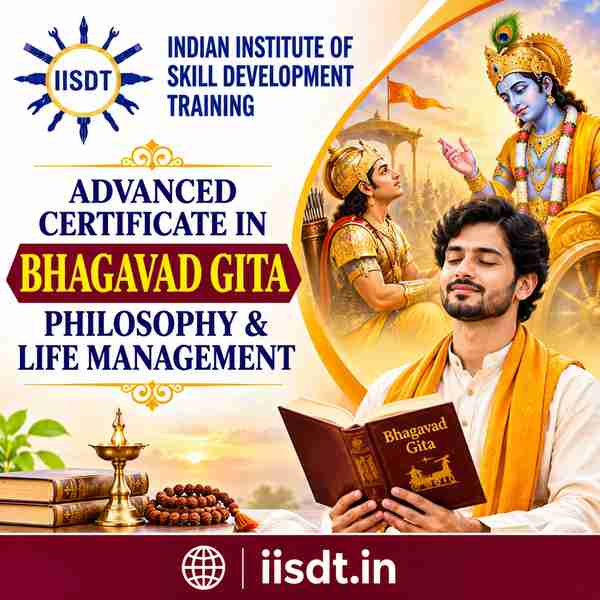
Advanced Certificate in Bhagavad Gita Philosophy & Life Management
₹7,500.00 ₹3,750.00
50% fee concession will end in
Advanced Certificate in Bhagavad Gita Philosophy & Life Management offers in-depth insights into Gita teachings, guiding learners in decision-making, self-mastery, leadership, mindfulness, and practical strategies for balanced personal and professional life.
Description
Course Name: Advanced Certificate in Bhagavad Gita Philosophy & Life Management
Course Id: ACBGPLM/Q0001
Eligibility: 10th Grade(High School) or Equivalent.
Objective: The Advanced Certificate in Bhagavad Gita Philosophy & Life Management explores profound teachings of the Bhagavad Gita, focusing on self-realization, dharma, karma, and emotional intelligence. Learners gain tools for effective life management, mindful decision-making, ethical leadership, stress resilience, and holistic personal and professional growth.
Duration: Three Months.
 How to Enroll and Get Certified in Your Chosen Course:
Step 1: Choose the course you wish to get certified in.
Step 2: Click on the “Enroll Now” button.
Step 3: Proceed with the enrollment process.
Step 4: Enter your billing details and continue to course fee payment.
Step 5: You will be redirected to the payment gateway. Pay the course and exam fee using one of the following methods:
Debit/Credit Card, Wallet, Paytm, Net Banking, UPI, or Google Pay.
Step 6: After successful payment, you will receive your study material login ID and password via email within 48 hours of fee payment.
Step 7: Once you complete the course, take the online examination.
Step 8: Upon passing the examination, you will receive:
• A soft copy (scanned) of your certificate via email within 7 days of examination.
• A hard copy (original with official seal and signature) sent to your address within 45 day of declaration of result.
Step 9: After certification, you will be offered job opportunities aligned with your area of interest.
Online Examination Detail:
Duration- 60 minutes.
No. of Questions- 30. (Multiple Choice Questions).
Maximum Marks- 100, Passing Marks- 40%.
There is no negative marking in this module.
| Marking System: | ||||||
| S.No. | No. of Questions | Marks Each Question | Total Marks | |||
| 1 | 10 | 5 | 50 | |||
| 2 | 5 | 4 | 20 | |||
| 3 | 5 | 3 | 15 | |||
| 4 | 5 | 2 | 10 | |||
| 5 | 5 | 1 | 5 | |||
| 30 | 100 | |||||
| How Students will be Graded: | ||||||
| S.No. | Marks | Grade | ||||
| 1 | 91-100 | O (Outstanding) | ||||
| 2 | 81-90 | A+ (Excellent) | ||||
| 3 | 71-80 | A (Very Good) | ||||
| 4 | 61-70 | B (Good) | ||||
| 5 | 51-60 | C (Average) | ||||
| 6 | 40-50 | P (Pass) | ||||
| 7 | 0-40 | F (Fail) | ||||
Key Benefits of Certification- Earning a professional certification not only validates your skills but also enhances your employability. Here are the major benefits you gain:
Practical, Job-Ready Skills – Our certifications are designed to equip you with real-world, hands-on skills that match current industry demands — helping you become employment-ready from day one.
Lifetime Validity – Your certification is valid for a lifetime — no renewals or expirations. It serves as a permanent proof of your skills and training.
Lifetime Certificate Verification – Employers and institutions can verify your certification anytime through a secure and reliable verification system — adding credibility to your qualifications.
Industry-Aligned Certification –All certifications are developed in consultation with industry experts to ensure that what you learn is current, relevant, and aligned with market needs.
Preferred by Employers – Candidates from ISO-certified institutes are often prioritized by recruiters due to their exposure to standardized, high-quality training.
Free Job Assistance Based on Your Career Interests – Receive personalized job assistance and career guidance in your preferred domain, helping you land the right role faster.
Syllabus:
Module 1: Ontological Foundations and Self-Mastery Introduction to the Philosophical Framework of the Gita, The Concept of Atman (Soul) vs. Anatman (Non-Self), , Understanding the Nature of Reality (Sat vs. Asat), The Three Bodies (Gross, Subtle, Causal) and the Five Sheaths (Pancha Kosha), , The Science of Sankhya Yoga and Discriminative Intellect, Overcoming the Fear of Death and Change, The Attributes of a Sthitaprajna (Steady Intellect), Developing Witness Consciousness (Sakshi Bhava), Mastering the Ego and Self-Identity, The Philosophy of Reincarnation and Evolution of Consciousness
Module 2: Strategic Action and Decision Making (Karma Yoga) The Doctrine of Nishkama Karma (Selfless Action), Analyzing the Five Factors of Action (Adhishthanam to Daivam), , Overcoming Performance Anxiety and Outcome-Obsession, The Law of Cause and Effect in Professional Life, Skill in Action (Karmasu Kaushalam) and Efficiency, Managing Conflict through the Lens of Swadharma (Personal Duty), , The Paradox of Action in Inaction and Inaction in Action, Leadership Ethics and Lokasamgraha (Universal Welfare), Strategic Planning and Intentionality, Handling Professional Failure and Success with Equanimity
Module 3: Emotional Intelligence and Guna Dynamics The Science of the Three Gunas (Sattva, Rajas, Tamas), , Psychosomatic Impact of Food and Diet on the Mind, The Ladder of Fall: From Attachment to Destruction, Managing Anger, Lust, and Greed (The Three Gates to Hell), Cultivating Emotional Resilience and Stability, The Psychology of Raga (Attachment) and Dvesha (Aversion), Transforming Stress into Strength through Sattvic Living, Identifying and Overcoming Tamasic Procrastination, Channeling Rajasic Energy for Productive Growth, Developing Empathy and Compassion through Oneness
Module 4: Cognitive Restructuring and Meditation (Dhyana Yoga) The Chariot Analogy for Mind and Sense Control, , Techniques of Concentration and One-Pointedness (Ekagrata), The Role of Pranayama (Breath) in Mental Health, Pratyahara: Withdrawal of Senses in a Digital Age, Overcoming Distractions and Cognitive Overload, Establishing a Daily Meditation Practice (Sadhana), The Power of Silence (Mauna) in Communication, Visualization Techniques for Personal Transformation, Mastering the Mind-Intellect Relationship, Reaching the State of Samadhi and Inner Peace
Module 5: Leadership, Governance, and Social Management The King-Sage (Rajarshi) Model of Leadership, Principles of Fair Governance and Justice (Dharma), Building High-Trust Teams through Shared Values, Conflict Resolution Strategies from the Battlefield, Managing Diversity and Inclusivity in Organizations, The Concept of Yajna (Sacrifice) in Corporate Social Responsibility, Motivating Others through Self-Example (Shrestha Character), Effective Communication and Truthfulness (Satya), Handling Power and Authority without Ego, Creating a Purpose-Driven Organizational Culture
Module 6: Integrated Life Management and Holistic Well-being Synthesis of the Four Paths (Karma, Bhakti, Jnana, Raja Yoga), , Developing a Personal Philosophy of Life, Integrating Spiritual Values with Material Success, The Role of Faith (Shraddha) in Human Potential, Achieving Work-Life Harmony (Yukta-Ahara-Vihara), Grace (Prasada) and Resilience in Times of Crisis, The Final Surrender: Reaching Absolute Freedom (Moksha), Building Sustainable Relationships and Social Bonds, Designing a Lifelong Spiritual Practice Plan, Capstone Project: Applied Gita Principles in a Management Case Study
Job Opportunities in Senior Gita-Based Life Coaching & Leadership
Careers focused on advanced coaching, leadership development, ethics, and personal transformation using deep Bhagavad Gita and Vedantic principles.
Top Roles: Senior Gita-Based Life Coach, Corporate Leadership & Ethics Consultant, Spiritual Counselor & Life Mentor, Advanced Gita Educator/Faculty, Motivational Speaker & Thought Leader, Author/Researcher/Content Strategist, Institutional & Community Spiritual Development Consultant
Key Skills: Bhagavad Gita, Vedanta philosophy, karma-based action, leadership ethics, decision-making, emotional intelligence, stress management, coaching, public speaking, content creation
Earnings & Salary Range (India):
- Entry-to-Mid Level: ₹25,000 – ₹80,000 per month/session/project
- Experienced / Established: ₹1,00,000 – ₹5,00,000+ per month/session/project
- High-profile / Senior Roles: ₹8 – ₹15 LPA+
Industries & Opportunities: Corporates, educational institutions, spiritual organizations, NGOs, online academies, leadership programs, workshops, consulting platforms
Scope: Advanced expertise in Gita philosophy, applied Vedanta, and ethical leadership, combined with corporate exposure, institutional collaborations, workshops, publications, and personal branding, enables high-impact roles and premium earning potential.



