No products in the cart.


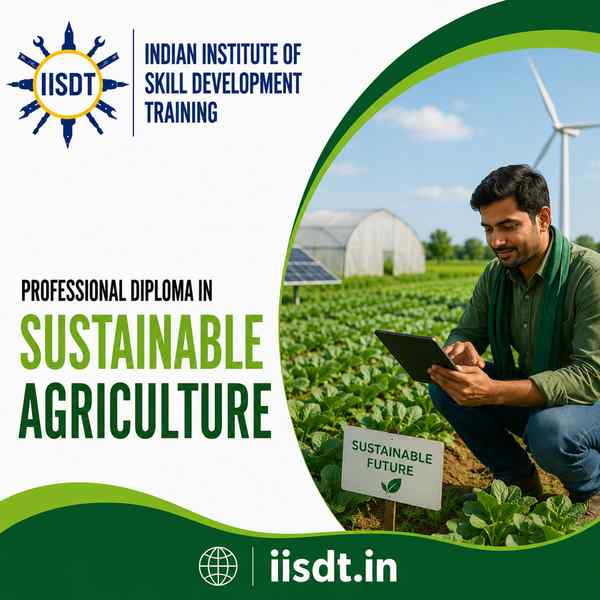
Professional Diploma in Sustainable Agriculture
₹10,500.00 ₹5,250.00
50% fee concession will end in
To equip learners with knowledge and skills to implement sustainable farming practices that improve agricultural productivity while conserving natural resources and protecting the environment.
Description
Course Name: Professional Diploma in Sustainable Agriculture
Course Id: PDSA/Q1001
Eligibility: 10+2(higher Secondary) or equivalent.
Objective: The Professional Diploma in Sustainable Agriculture is designed to equip learners with the knowledge and skills required to develop and manage environmentally responsible, economically viable, and socially sustainable agricultural practices. The course focuses on modern farming techniques that improve productivity while conserving natural resources and maintaining ecological balance.
Duration: Six Months.
How to Enroll and Get Certified in Your Chosen Course:
Step 1: Choose the course you wish to get certified in.
Step 2: Click on the “Enroll Now” button.
Step 3: Proceed with the enrollment process.
Step 4: Enter your billing details and continue to course fee payment.
Step 5: You will be redirected to the payment gateway. Pay the course and exam fee using one of the following methods:
Debit/Credit Card, Wallet, Paytm, Net Banking, UPI, or Google Pay.
Step 6: After successful payment, you will receive your study material login ID and password via email within 48 hours of fee payment.
Step 7: Once you complete the course, take the online examination.
Step 8: Upon passing the examination, you will receive:
• A soft copy (scanned) of your certificate via email within 7 days of examination.
• A hard copy (original with official seal and signature) sent to your address within 45 day of declaration of result.
Step 9: After certification, you will be offered job opportunities aligned with your area of interest.
Online Examination Detail:
Duration- 120 minutes.
No. of Questions- 60. (Multiple Choice Questions).
10 Questions from each module, each carry 10 marks.
Maximum Marks- 600, Passing Marks- 40%.
There is no negative marking in this module.
| How Students will be Graded: | ||
| S.No. | Marks | Grade |
| 1 | 91-100 | O (Outstanding) |
| 2 | 81-90 | A+ (Excellent) |
| 3 | 71-80 | A (Very Good) |
| 4 | 61-70 | B (Good) |
| 5 | 51-60 | C (Average) |
| 6 | 41-50 | P (Pass) |
| 7 | 0-40 | F (Fail) |
Key Benefits of Certification- Earning a professional certification not only validates your skills but also enhances your employability. Here are the major benefits you gain:
Practical, Job-Ready Skills – Our certifications are designed to equip you with real-world, hands-on skills that match current industry demands — helping you become employment-ready from day one.
Lifetime Validity – Your certification is valid for a lifetime — no renewals or expirations. It serves as a permanent proof of your skills and training.
Lifetime Certificate Verification – Employers and institutions can verify your certification anytime through a secure and reliable verification system — adding credibility to your qualifications.
Industry-Aligned Certification –All certifications are developed in consultation with industry experts to ensure that what you learn is current, relevant, and aligned with market needs.
Preferred by Employers – Candidates from ISO-certified institutes are often prioritized by recruiters due to their exposure to standardized, high-quality training.
Free Job Assistance Based on Your Career Interests – Receive personalized job assistance and career guidance in your preferred domain, helping you land the right role faster.
Syllabus
Module 1: Fundamentals of Sustainable Agriculture: Introduction to Sustainable Agriculture, Principles of Sustainable Farming, Agricultural Ecosystems, Soil Science Fundamentals, Climate-Smart Agriculture, Sustainable Development Goals (SDGs) in Agriculture, Agricultural Policies and Government Schemes, Farm Planning and Resource Management, Professional Ethics in Agriculture, Career Opportunities in Sustainable Agriculture
Module 2: Soil, Water and Crop Management: Soil Health and Fertility Management, Organic Matter and Composting, Crop Rotation and Diversification, Integrated Nutrient Management, Water Conservation Techniques, Irrigation Management, Rainwater Harvesting for Agriculture, Seed Selection and Crop Planning, Sustainable Weed Management, Post-Harvest Handling and Storage
Module 3: Sustainable Farming Practices and Resource Conservation: Organic Farming Principles, Natural Farming Techniques, Integrated Pest Management (IPM), Integrated Farming Systems, Agroforestry Practices, Livestock Integration in Farming, Biodiversity Conservation, Waste Recycling and Circular Agriculture, Renewable Energy in Agriculture, Farm Record Management
Module 4: Agri-Business and Farm Economics: Agricultural Economics Fundamentals, Farm Budgeting and Cost Analysis, Agricultural Marketing Strategies, Value Addition of Farm Products, Supply Chain and Logistics Management, Packaging and Branding of Agricultural Products, Farmer Producer Organizations (FPOs), Agricultural Credit and Insurance, Entrepreneurship in Agriculture, Government Support and Subsidy Programs
Module 5: Smart Agriculture and Digital Technologies: Precision Agriculture Fundamentals, Artificial Intelligence in Agriculture, Internet of Things (IoT) for Smart Farming, Drone Applications in Agriculture, Geographic Information Systems (GIS) Basics, Remote Sensing Applications, Farm Management Software, Data Analytics for Agriculture, Digital Marketing for Agricultural Products, Emerging AgriTech Innovations
Module 6: Leadership, Innovation and Professional Practice: Sustainable Farm Business Planning, Climate Risk Assessment and Adaptation, Carbon Farming and Environmental Stewardship, Leadership and Team Management, Project Management for Agricultural Enterprises, Research and Innovation in Sustainable Agriculture, International Sustainable Agriculture Practices, Capstone Project in Sustainable Agriculture, Professional Development and Career Planning, Future Trends in Sustainable Agriculture
Job Opportunities after Professional Diploma in Sustainable Agriculture
Graduates of this program gain expertise in eco-friendly farming practices, soil health management, organic cultivation, water conservation, crop planning, sustainable food systems, and agricultural innovation, preparing them for diverse roles across agriculture, agribusiness, NGOs, and rural development organizations.
Key Career Options: Sustainable Agriculture Executive, Organic Farming Consultant, Agricultural Field Officer, Crop Management Assistant, Soil Health Analyst (Junior Level), Agribusiness Executive, Farm Manager (Sustainable Practices), Agricultural Extension Officer, Rural Development Executive, Organic Certification Assistant, Agro-Consultant (Entry Level), Horticulture Assistant, Environmental Agriculture Executive, Green Farming Coordinator, Food Security Project Assistant.
Salary Range (India):
Entry-level: ₹2.5–5 LPA
Mid-level: ₹5–9 LPA
Senior-level: ₹9–18+ LPA
Industries Hiring Graduates: Agriculture Sector, Agri-Tech Companies, Organic Farming Businesses, NGOs, Government Agricultural Departments, Food Processing Industry, Rural Development Agencies, Agribusiness Firms, Environmental Organizations, Research Institutes.
Skills Developed: Sustainable farming techniques, soil management, organic cultivation, irrigation planning, crop rotation systems, environmental awareness, farm management, data collection, communication skills, and agricultural innovation basics.
Graduates can progress to senior agricultural consultancy roles, agribusiness management positions, sustainable farming leadership, or rural development advisory careers, with further growth through certifications in agronomy, organic farming, agricultural science, and environmental sustainability.