No products in the cart.


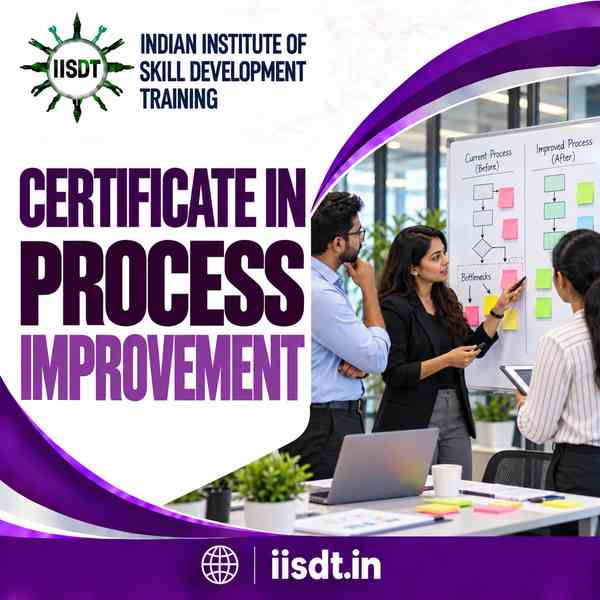
Certificate in Process Improvement
₹7,000.00 ₹3,500.00
50% fee concession will end in
To develop basic skills in process analysis, workflow improvement, problem identification, waste reduction, quality improvement, and performance monitoring.
Description
Course Name: Certificate in Process Improvement
Course Id: CPI/Q0001.
Eligibility: 10+2 (Higher Secondary) or equivalent.
Objective: The Certificate in Process Improvement develops practical professional skills required to identify, analyze and improve inefficient organizational processes. The course covers process assessment, process mapping, performance analysis, bottleneck identification, root cause analysis, waste reduction, workflow optimization, problem-solving, continuous improvement, change implementation and improvement performance monitoring. It prepares learners to identify process gaps, eliminate unnecessary activities, improve workflow efficiency, reduce delays and errors, support improvement initiatives and contribute to better operational quality, productivity and customer satisfaction.
Duration: Three Months.
How to Enroll and Get Certified in Your Chosen Course:
Step 1: Choose the course you wish to get certified in.
Step 2: Click on the “Enroll Now” button.
Step 3: Proceed with the enrollment process.
Step 4: Enter your billing details and continue to course fee payment.
Step 5: You will be redirected to the payment gateway. Pay the course and examination fee using one of the following methods:
Debit/Credit Card, Wallet, Paytm, Net Banking, UPI, or Google Pay.
Step 6: After successful payment, you will receive your study material login ID and password via email within 48 hours of fee payment.
Step 7: Once you complete the course, take the online examination.
Step 8: Upon passing the examination, you will receive:
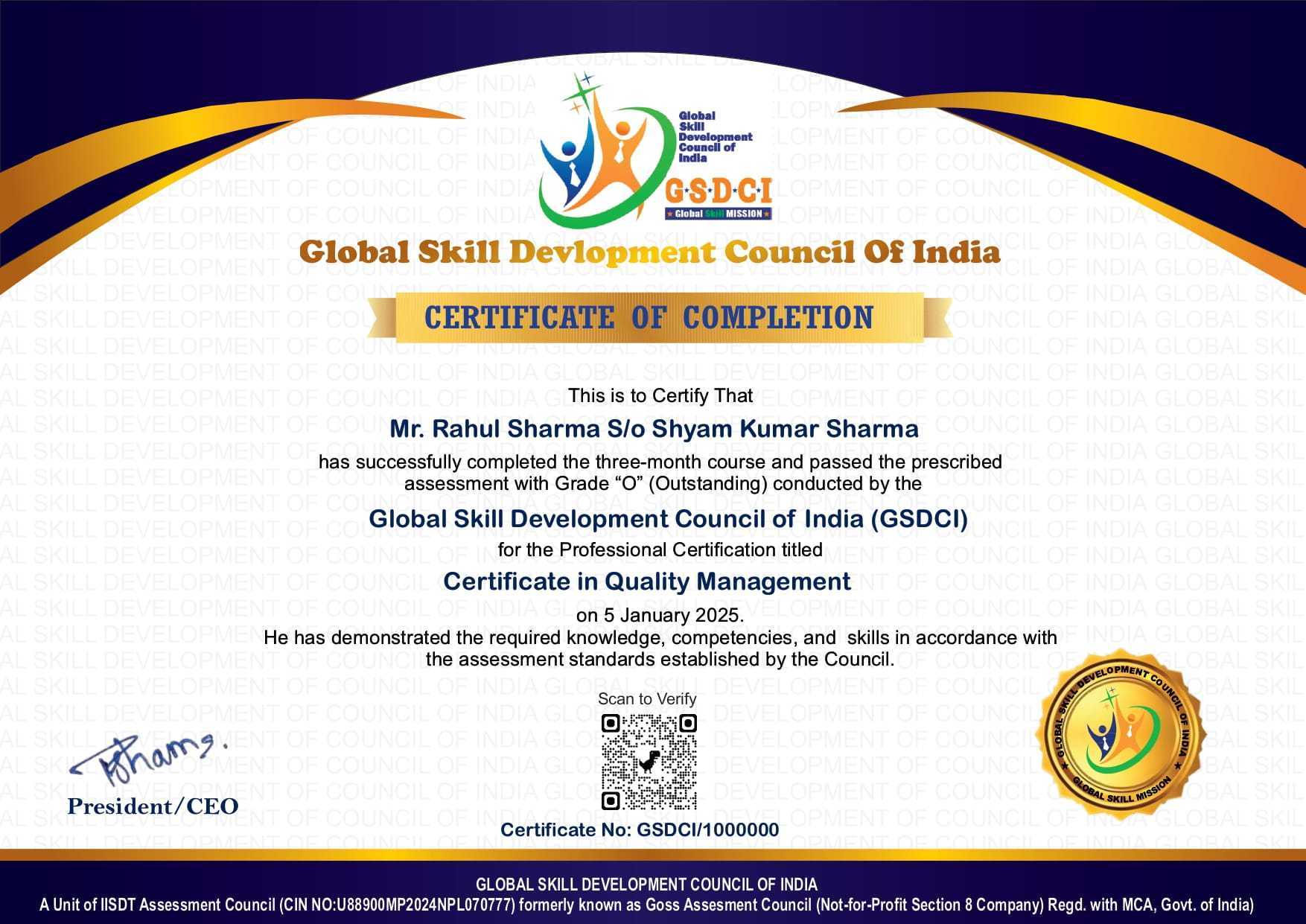
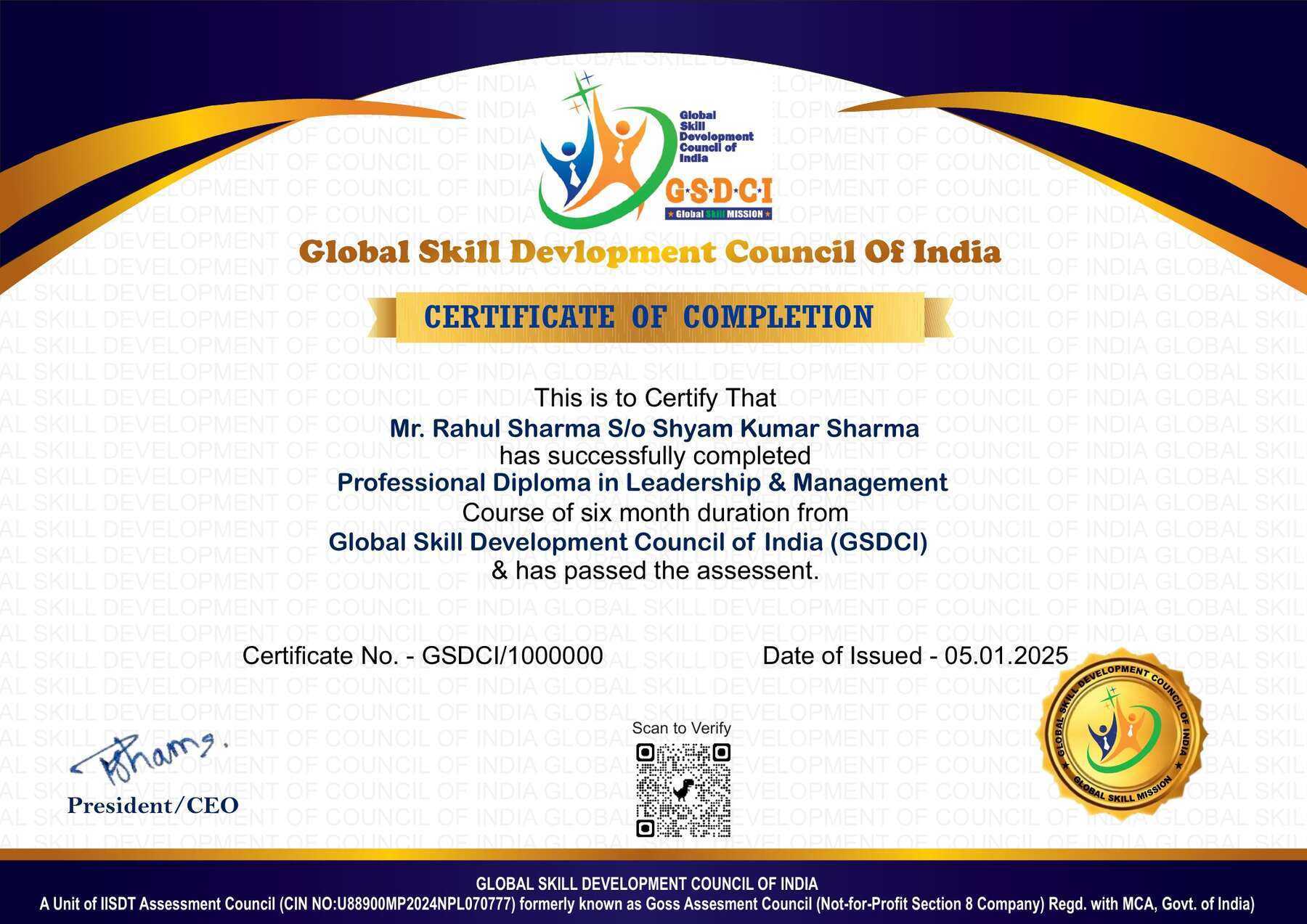
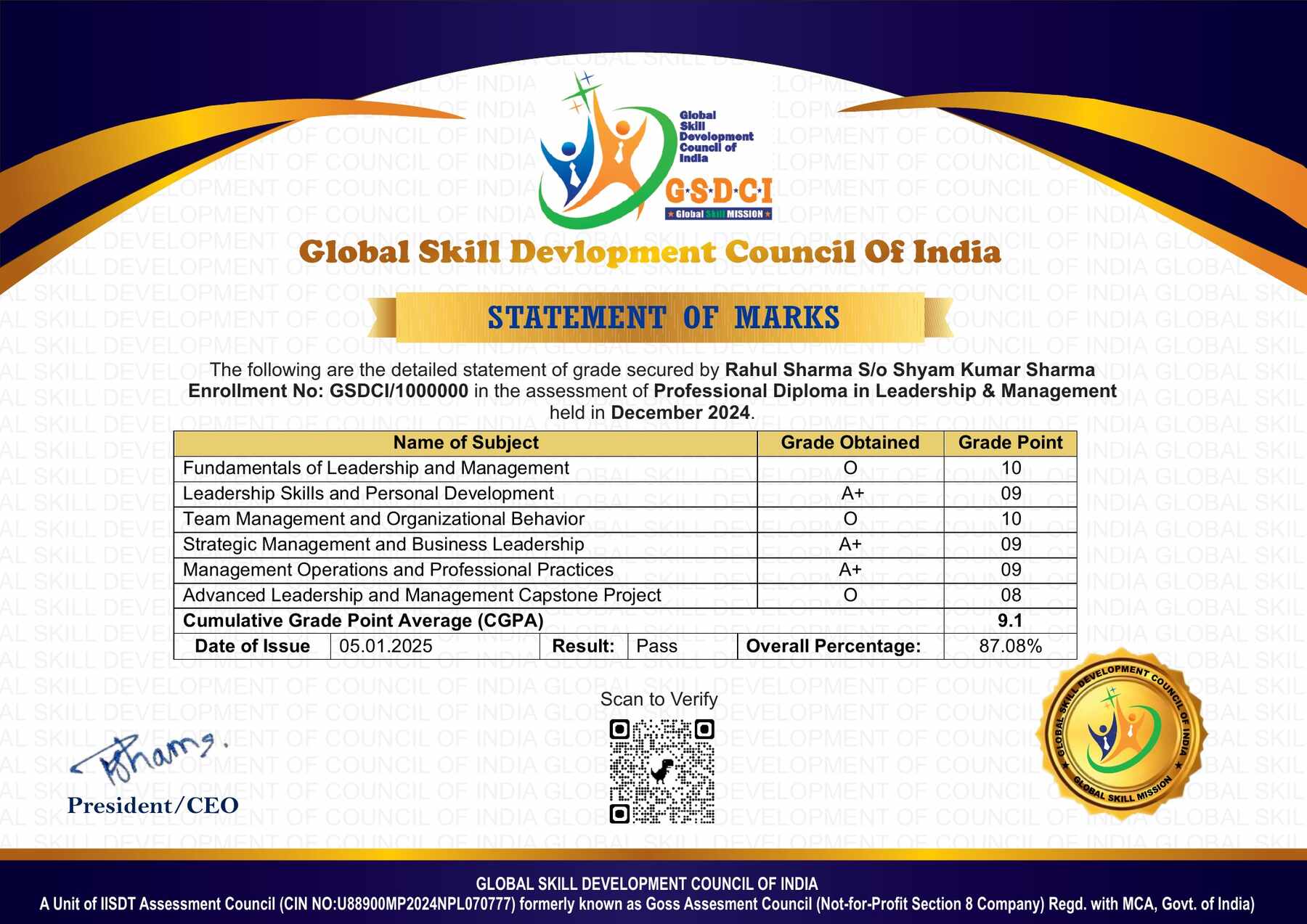
- A soft copy (scanned) of your certificate via email within 7 days of the examination.
- A hard copy (original with official seal and signature) sent to your address within 45 days of the declaration of the result.
Step 9: After certification, you will be offered job opportunities aligned with your area of interest.
Online Examination Detail:
Duration- 60 minutes.
No. of Questions- 30. (Multiple Choice Questions).
Maximum Marks- 100, Passing Marks- 40%.
There is no negative marking in this module.
| Marking System: | ||||||
| S.No. | No. of Questions | Marks Each Question | Total Marks | |||
| 1 | 10 | 5 | 50 | |||
| 2 | 5 | 4 | 20 | |||
| 3 | 5 | 3 | 15 | |||
| 4 | 5 | 2 | 10 | |||
| 5 | 5 | 1 | 5 | |||
| 30 | 100 | |||||
| How Students will be Graded: | ||||||
| S.No. | Marks | Grade | ||||
| 1 | 91-100 | O (Outstanding) | ||||
| 2 | 81-90 | A+ (Excellent) | ||||
| 3 | 71-80 | A (Very Good) | ||||
| 4 | 61-70 | B (Good) | ||||
| 5 | 51-60 | C (Average) | ||||
| 6 | 40-50 | P (Pass) | ||||
| 7 | 0-40 | F (Fail) | ||||
Key Benefits of Certification- Earning a professional certification not only validates your skills but also enhances your employability. Here are the major benefits you gain:
Practical, Job-Ready Skills – Our certifications are designed to equip you with real-world, hands-on skills that match current industry demands — helping you become employment-ready from day one.
Lifetime Validity – Your certification is valid for a lifetime — no renewals or expirations. It serves as a permanent proof of your skills and training.
Lifetime Certificate Verification – Employers and institutions can verify your certification anytime through a secure and reliable verification system — adding credibility to your qualifications.
Industry-Aligned Certification –All certifications are developed in consultation with industry experts to ensure that what you learn is current, relevant, and aligned with market needs.
Preferred by Employers – Candidates from ISO-certified institutes are often prioritized by recruiters due to their exposure to standardized, high-quality training.
Free Job Assistance Based on Your Career Interests – Receive personalized job assistance and career guidance in your preferred domain, helping you land the right role faster.
Syllabus
Module 1: Fundamentals of Process Improvement: Meaning and Scope of Process Improvement, Importance of Improving Organizational Processes, Objectives of Process Improvement, Process Improvement Life Cycle, Understanding Process Inputs and Outputs, Identifying Process Customers and Requirements, Process Ownership and Responsibilities, Principles of Continuous Improvement, Relationship Between Quality and Process Improvement, Developing a Process Improvement Mindset.
Module 2: Process Mapping and Current-State Assessment: Identifying Processes for Improvement, Defining Process Boundaries, Mapping Process Activities and Tasks, Understanding Activity Sequence and Dependencies, Developing Current-State Process Maps, Identifying Process Handoffs, Collecting Process Information, Observing Existing Workflows, Identifying Process Gaps and Weaknesses, Establishing a Baseline for Improvement.
Module 3: Process Performance and Problem Analysis: Identifying Process Performance Requirements, Process Performance Indicators, Measuring Process Cycle Time, Monitoring Process Quality and Errors, Identifying Delays and Bottlenecks, Analyzing Resource Utilization, Identifying Rework and Duplication, Process Gap Analysis, Prioritizing Process Problems, Using Performance Information for Improvement Decisions.
Module 4: Root Cause Analysis and Improvement Tools: Fundamentals of Root Cause Analysis, Problem Definition Techniques, Cause-and-Effect Analysis, Five Whys Technique, Pareto Analysis, Check Sheets for Process Data, Flowchart-Based Problem Analysis, Identifying Causes of Process Variation, Distinguishing Symptoms from Root Causes, Selecting Appropriate Corrective Improvements.
Module 5: Waste Reduction and Workflow Optimization: Understanding Value-Added Activities, Identifying Non-Value-Added Activities, Common Types of Process Waste, Eliminating Unnecessary Process Steps, Reducing Waiting Time and Delays, Minimizing Rework and Errors, Simplifying Process Handoffs, Improving Workflow Coordination, Standardizing Improved Work Methods, Designing Efficient Future-State Processes.
Module 6: Improvement Implementation and Performance Review: Developing Process Improvement Action Plans, Prioritizing Improvement Activities, Assigning Improvement Responsibilities, Implementing Process Changes, Managing Employee Communication and Participation, Monitoring Improvement Progress, Comparing Results with Baseline Performance, Corrective Adjustment of Improvement Actions, Standardizing and Sustaining Improved Processes, Digital Tools and Emerging Practices in Process Improvement.
Job Opportunities after Certificate in Process Improvement
Graduates can pursue opportunities in process improvement, operational improvement, workflow optimization, process analysis, quality improvement, productivity support, continuous improvement and business operations.
Top Roles: Process Improvement Assistant, Junior Process Improvement Executive, Process Analyst Assistant, Continuous Improvement Assistant, Operations Improvement Assistant, Workflow Improvement Coordinator, Process Quality Assistant, Business Process Assistant and Operational Excellence Assistant.
Key Skills: Process improvement, process mapping, workflow assessment, performance analysis, bottleneck identification, root cause analysis, problem-solving, waste reduction, workflow optimization, process standardization, continuous improvement and performance monitoring.
Salary Range (India):
- Entry-level: ₹3–6 LPA
- Mid-level: ₹6–12 LPA
- Senior-level: ₹12–20+ LPA
Scope: Process improvement professionals can work in manufacturing companies, IT and IT-enabled services, banking and financial services, healthcare organizations, logistics companies, retail businesses, consulting firms, business process outsourcing organizations, e-commerce companies, service organizations and corporate operations departments requiring workflow optimization, waste reduction, productivity improvement, process standardization and continuous operational improvement.