
No products in the cart.



Certified Chief Risk Officer (CRO)
₹6,500.00 ₹3,250.00
50% fee concession will end in
The course prepares learners to identify, assess, and manage organizational risks effectively, enabling strategic decision-making and ensuring long-term business resilience.
Description
Certification Name: Certified Chief Risk Officer (CRO)
Global Occupational Skill Standard – GOSS ID: GOSS/BAF/CCRO/V1
Eligibility: Graduation or Equivalent or minimum 2 years of relevant experience (experience-based learners can directly enroll and certify).
Objective: The Certified Chief Risk Officer (CRO) course is designed to provide participants with comprehensive knowledge and practical skills in enterprise risk management, enabling them to lead and oversee an organization’s risk framework effectively. The course covers key areas such as credit risk, market risk, operational risk, liquidity risk, regulatory compliance, and strategic risk management.
Certification: Within 5 days after Completion of Online Assessment.
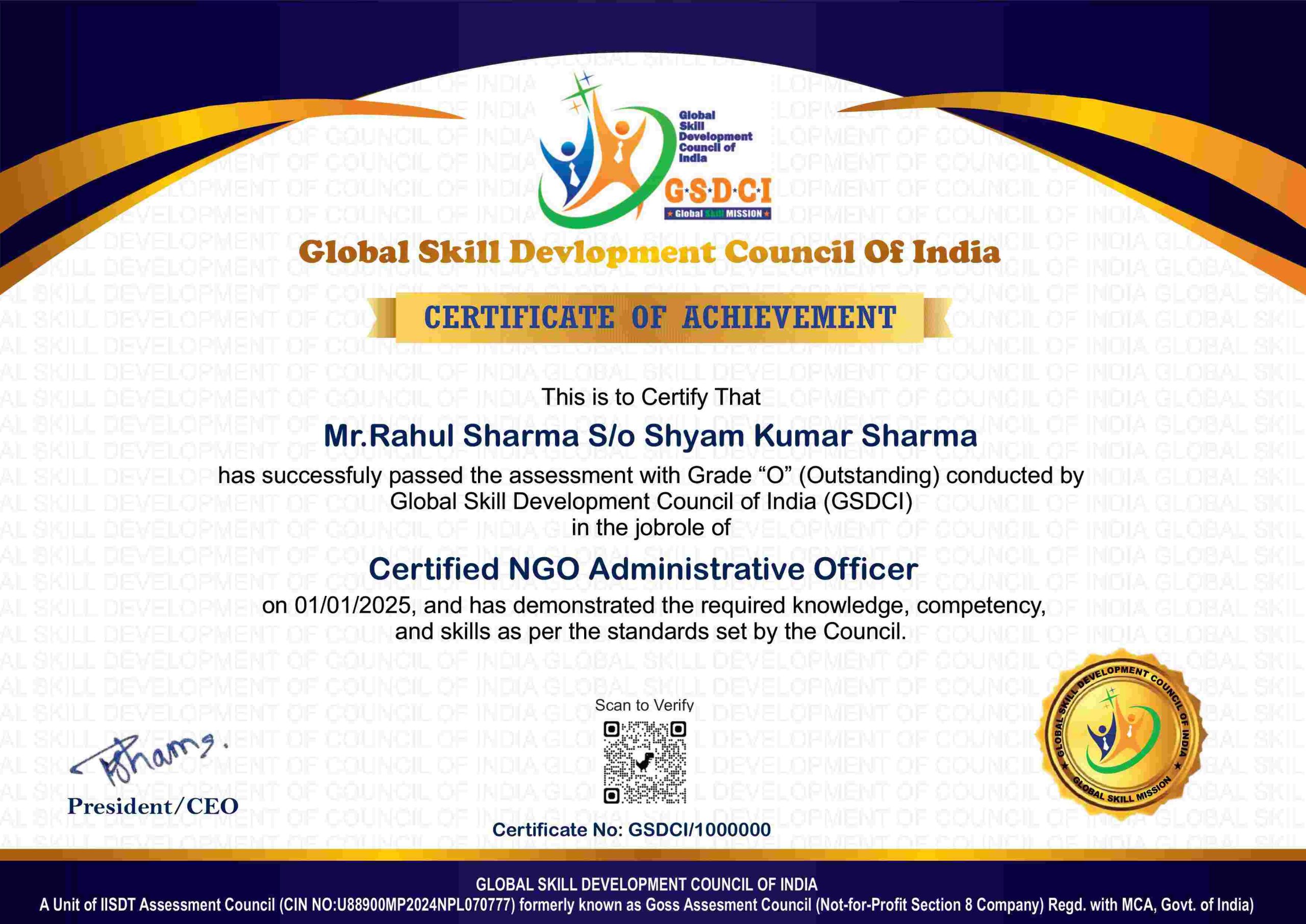
Get ready to join the Journey to become a GSDCI Certified Professional – International Certification and Assessment Body.
Steps to become a GSDCI Certified Professional:
Step 1: Select your certification you want to pursue.
Step 2: Click on get certified tab, new pop up window will open.
Step 3: Click on pay certification fee, you will be redirected to billing details page.
Step 4: Fill your details and click on pay certification fee, you will be redirected to payment gateway, pay fee by any available options like Card (Debit/Credit), Wallet, Paytm, Net banking, UPI and Google pay.
Step 5: You will get Login Credentials of Online E-Books and Online assessment link on your email id, within 48 hrs of payment.
Step 6: After completion of online assessment, you can download your Certificate Immediately.
Assessment Modules:
Module 1: Strategic Role & Governance of the CRO: Understanding the evolving role of the CRO in the C‑suite, Designing the risk governance framework and risk committees, Establishing risk appetite, tolerance and the risk strategy, Interfacing with the Board, Audit & Risk Committee and senior management, Building an effective risk culture, Leadership, change management and the CRO as a business partner
Module 2: Enterprise Risk Management (ERM) Framework: Overview of ERM: definitions, scope and objectives, Identifying and categorising enterprise risks (financial, strategic, operational, compliance, reputational), Risk assessment methodologies (qualitative & quantitative), Risk response strategies (avoid, mitigate, transfer, accept), Framework for monitoring, reporting and escalation of risks, Embedding ERM in business strategy and decision‑making
Module 3: Financial Risks: Credit, Market, Liquidity: Credit risk: assessment, measurement, portfolio management and early‑warning indicators, Market risk: value‑at‑risk (VaR), interest rate risk, foreign exchange risk, hedging strategies, Liquidity risk: funding risk, cash‑flow mismatch, contingency funding plans, Capital adequacy, regulatory constraints (e.g., Basel III/Basel IV), Integrating financial and non‑financial risk into a unified view
Module 4: Non‑Financial Risks: Operational, Compliance, Strategic & Emerging: Operational risk: process failures, system failures, human risk, business continuity and scenario analysis, Compliance and legal risk: regulatory change, sanctions, KYC/AML, third‑party risk, Strategic risk: disruption, business model risk, competitive risk, Emerging risks: cyber risk, climate risk, ESG risk, AI/ML risk, Aggregation and correlation of emerging risks
Module 5: Risk Tools, Analytics, Reporting & Scenario Management: Risk data architecture and infrastructure: data aggregation, quality and governance, Key risk indicators (KRIs), dashboards and metrics, Stress testing, scenario analysis and reverse stress testing, Risk modelling and quantitative tools, Risk reporting frameworks to management and Board, Communicating risk effectively to business lines and senior leadership
Module 6: Regulatory Environment, Crisis Management & Future of Risk: Global regulatory frameworks and supervision (Basel, IFRS 9, resolution regimes), Regulatory relationships and examination readiness, Crisis management, contingency planning and resolution frameworks, Conduct, culture and ethics in risk management, Technology and RegTech in risk: automation, machine learning, big data, The future of risk leadership: digitalisation, sustainability/ESG, geopolitical risk and next‑gen risk functions
GSDCI Online Assessment Detail:
- Duration- 60 minutes.
- Number of Questions- 30.
- Number of Questions from each module: 5.
- Language: English.
- Exam Type: Multiple Choice Questions.
- Maximum Marks- 100, Passing Marks- 50%.
- There is no negative marking in any module.
| Marking System: | |||
| S.No. | No. of Questions | Marks Each Question | Total Marks |
| 1 | 10 | 5 | 50 |
| 2 | 5 | 4 | 20 |
| 3 | 5 | 3 | 15 |
| 4 | 5 | 2 | 10 |
| 5 | 5 | 1 | 5 |
| 30 | 100 | ||
| How Students will be Graded: | |||
| S.No. | Marks | Grade | |
| 1 | 91-100 | O (Outstanding) | |
| 2 | 81-90 | A+ (Excellent) | |
| 3 | 71-80 | A (Very Good) | |
| 4 | 61-70 | B (Good) | |
| 5 | 50-60 | P (Pass) | |
| 6 | 0-49 | F (Fail) | |
Benefits of Certification:
🌍 1. Global Recognition & Credibility – Stand out worldwide with a certification that opens doors across borders. Trusted by employers, respected by institutions, and recognized in over 100 countries.
📜 2. Quality Assurance through ISO Certification – Certified to global ISO standards, our programs deliver excellence, consistency, and a benchmarked learning experience that speaks for itself.
💼 3. Career Advancement & Employability – Enhances your resume and increases chances of promotions or job offers.
🤝 4. Non-Profit Trust Factor – Certifications from non-profit organizations are mission-driven rather than profit-driven.
📚 5. Access to Verified Learning & Resources – Often includes e-books, mock tests, and online support without hidden costs.
🔍 6. Transparency & Online Verification – Certifications come with a unique Enrolment ID for easy online verification by employers and institutions.
⏳ 7. Lifetime or Long-Term Validity – Certifications usually have lifetime validity or long-term recognition, reducing the need for frequent renewals.