
No products in the cart.


Certified Environmental Journalist
₹6,500.00 ₹3,250.00
50% fee concession will end in
To equip professionals with the skills to report on environmental issues accurately, ethically, and effectively across multiple media platforms.
Description
Certification Name: Certified Environmental Journalist
Global Occupational Skill Standard – GOSS ID: GOSS/JPM/CEJ/V1
Eligibility: 10+2 or Equivalent or minimum 2 years of relevant experience (experience-based learners can directly enroll and certify).
Objective: The Certified Environmental Journalist course is designed to train participants in researching, analyzing, and reporting environmental issues with clarity, depth, and responsibility. The course covers core journalistic principles alongside environmental topics such as climate change, biodiversity, conservation, pollution, sustainable development, environmental policies, and community impact.
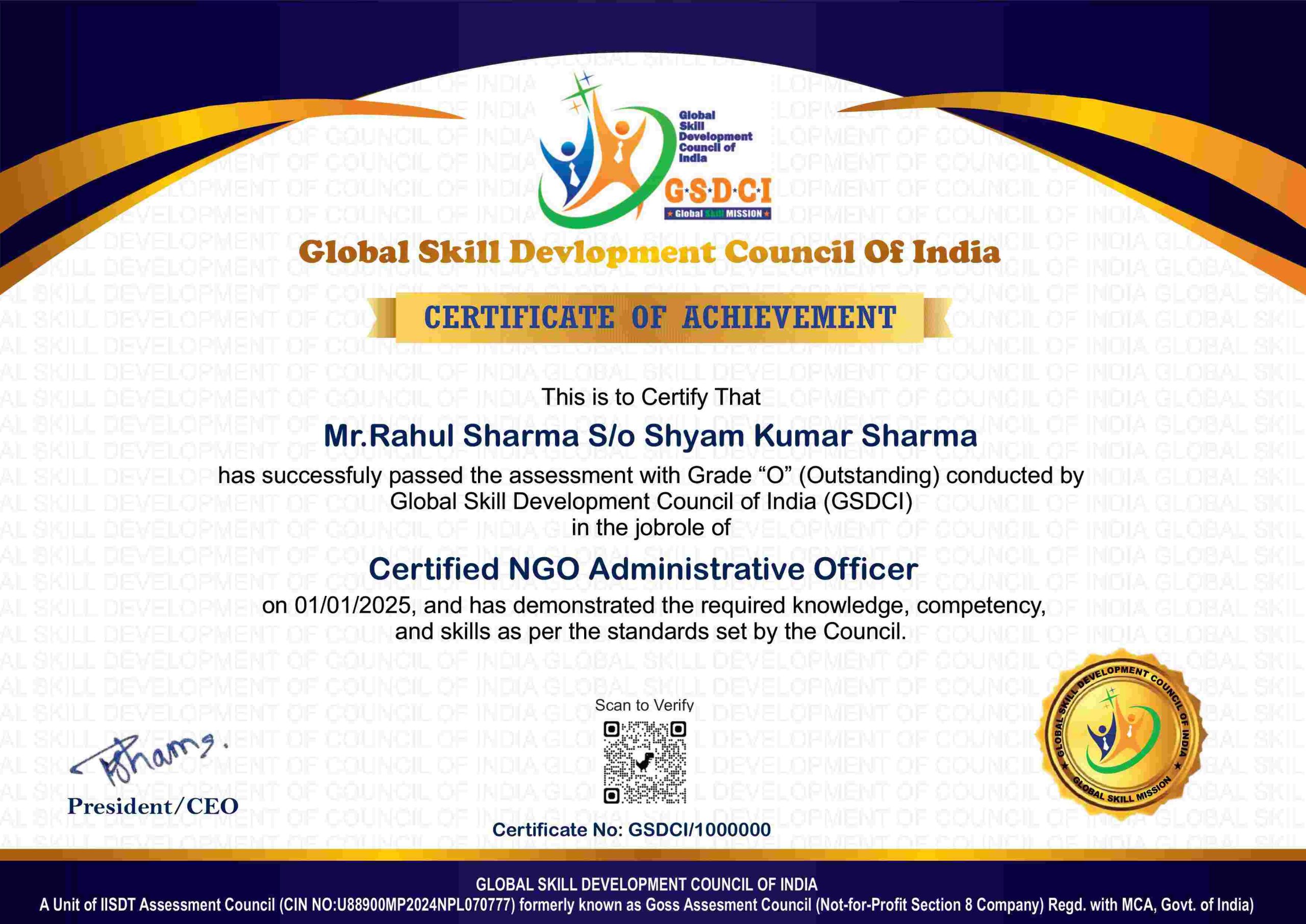
Certification: Within 5 days after Completion of Online Assessment.
Get ready to join the Journey to become a GSDCI Certified Professional – International Certification and Assessment Body.
Steps to become a GSDCI Certified Professional:
Step 1: Select your certification you want to pursue.
Step 2: Click on get certified tab, new pop up window will open.
Step 3: Click on pay certification fee, you will be redirected to billing details page.
Step 4: Fill your details and click on pay certification fee, You will be redirected to payment gateway, pay fee by any available options like Card(Debit/Credit), Wallet, Paytm, Net banking, UPI and Google pay.
Step 5: You will get Login Credentials of Online E-Books and Online assessment link on your email id, within 48 hrs of payment.
Step 6: After completion of online assessment, you can download your Certificate Immediately.
Assessment Modules:
Module 1: Introduction to Environmental Journalism: Role and importance of environmental journalism, Historical evolution and key movements in environmental reporting, Differences between environmental journalism and advocacy, Overview of key global environmental issues (climate change, biodiversity loss, pollution), Environmental journalism ethics and responsibilities, Understanding audiences and community relevance.
Module 2: Environmental Science and Policy Basics: Basic concepts in ecology, climate science, and sustainability, Overview of international agreements (UNFCCC, Paris Agreement, CBD), Understanding environmental laws and regulatory bodies, Interpreting scientific reports and environmental data, Role of NGOs, activists, and watchdogs in policy monitoring, Science-policy-media interface.
Module 3: Investigative Reporting and Field Techniques: Covering environmental crimes and corporate accountability, Investigating pollution, deforestation, wildlife trafficking, and land grabs, Techniques for data journalism and FOIA requests, Field reporting skills and risk management, Building and protecting sources in sensitive areas, Using satellite imagery and open-source tools.
Module 4: Writing and Multimedia Storytelling: Writing impactful environmental news, features, and opinion pieces, Explaining technical environmental topics in plain language, Creating visual content (photos, infographics, maps) for storytelling, Producing environmental podcasts and videos, Structuring long-form environmental reports, Maintaining tone, balance, and accuracy.
Module 5: Digital Tools and Community Engagement: Using social media for environmental awareness and real-time reporting, Tracking environmental misinformation and greenwashing, Crowdsourcing environmental data and citizen journalism, Engaging local communities in environmental coverage, Mobile tools and apps for eco-reporting, Building interactive maps and storytelling platforms.
Module 6: Professional Development and Global Trends: Building a niche and personal brand in environmental journalism, Freelancing opportunities and pitching eco-stories, Networking with environmental organizations and media houses, Attending conferences and fellowships (EJN, GIJN, SEJ), Monitoring emerging environmental issues and innovation, Career paths and continuous learning in environmental journalism.
GSDCI Online Assessment Detail:
- Duration- 60 minutes.
- Number of Questions- 30.
- Number of Questions from each module: 5.
- Language: English.
- Exam Type: Multiple Choice Questions.
- Maximum Marks- 100, Passing Marks- 50%.
- There is no negative marking in any module.
| Marking System: | |||
| S.No. | No. of Questions | Marks Each Question | Total Marks |
| 1 | 10 | 5 | 50 |
| 2 | 5 | 4 | 20 |
| 3 | 5 | 3 | 15 |
| 4 | 5 | 2 | 10 |
| 5 | 5 | 1 | 5 |
| 30 | 100 | ||
| How Students will be Graded: | |||
| S.No. | Marks | Grade | |
| 1 | 91-100 | O (Outstanding) | |
| 2 | 81-90 | A+ (Excellent) | |
| 3 | 71-80 | A (Very Good) | |
| 4 | 61-70 | B (Good) | |
| 5 | 50-60 | P (Pass) | |
| 6 | 0-49 | F (Fail) | |
Benefits of Certification:
🌍 1. Global Recognition & Credibility – Stand out worldwide with a certification that opens doors across borders. Trusted by employers, respected by institutions, and recognized in over 100 countries.
📜 2. Quality Assurance through ISO Certification – Certified to global ISO standards, our programs deliver excellence, consistency, and a benchmarked learning experience that speaks for itself.
💼 3. Career Advancement & Employability – Enhances your resume and increases chances of promotions or job offers.
🤝 4. Non-Profit Trust Factor – Certifications from non-profit organizations are mission-driven rather than profit-driven.
📚 5. Access to Verified Learning & Resources – Often includes e-books, mock tests, and online support without hidden costs.
🔍 6. Transparency & Online Verification – Certifications come with a unique Enrolment ID for easy online verification by employers and institutions.
⏳ 7. Lifetime or Long-Term Validity – Certifications usually have lifetime validity or long-term recognition, reducing the need for frequent renewals.