
No products in the cart.


Certified Job Safety Analysis Practitioner
₹6,000.00 ₹3,000.00
50% fee concession will end in
To train professionals to conduct effective Job Safety Analyses (JSA) to identify job-related hazards and implement controls for safe task execution.
Description
Certification Name: Certified Job Safety Analysis Practitioner
Global Occupational Skill Standard – GOSS ID: GOSS/FS/CJSAP/V1
Eligibility: Graduation or Equivalent or minimum 2 years of relevant experience (experience-based learners can directly enroll and certify).
Objective: The Certified Job Safety Analysis Practitioner course is designed to equip participants with practical knowledge and step-by-step methodologies to perform JSAs across various industries. The course covers task breakdown, hazard identification at each step, risk evaluation, development of safe work procedures, and implementation of control measures based on the hierarchy of controls.
Certification: Within 5 days after Completion of Online Assessment.
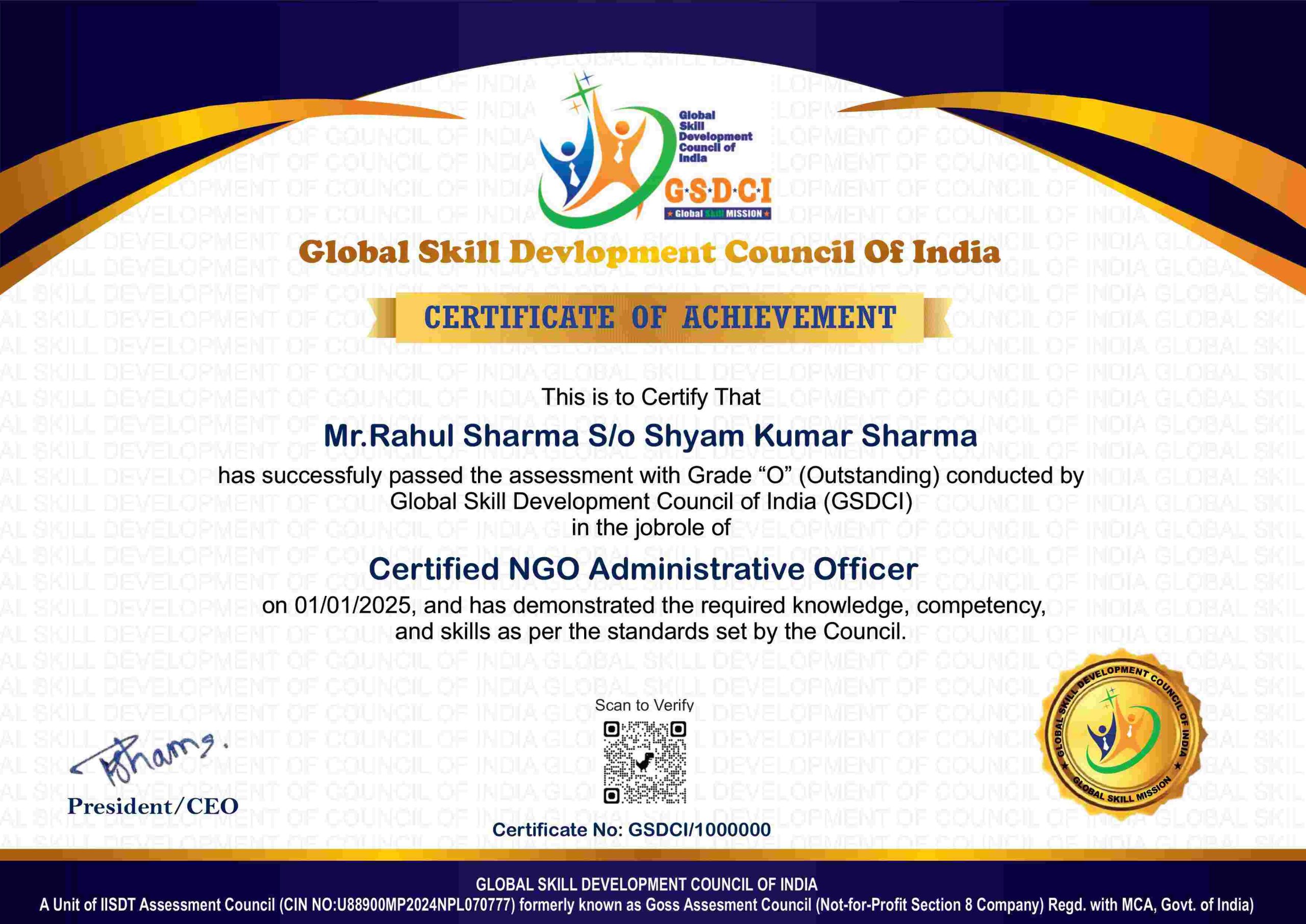
Get ready to join the Journey to become a GSDCI Certified Professional – International Certification and Assessment Body.
Steps to become a GSDCI Certified Professional:
Step 1: Select your certification you want to pursue.
Step 2: Click on get certified tab, new pop up window will open.
Step 3: Click on pay certification fee, you will be redirected to billing details page.
Step 4: Fill your details and click on pay certification fee, You will be redirected to payment gateway, pay fee by any available options like Card(Debit/Credit), Wallet, Paytm, Net banking, UPI and Google pay.
Step 5: You will get Login Credentials of Online E-Books and Online assessment link on your email id, within 48 hrs of payment.
Step 6: After completion of online assessment, you can download your Certificate Immediately.
Assessment Modules:
Module 1: Introduction to Job Safety Analysis (JSA): Definition and purpose of Job Safety Analysis, Benefits of JSA in accident prevention and risk control, Legal and regulatory framework supporting JSA (OSHA, ISO 45001), Differences between JSA, risk assessment, and hazard analysis, Role of a Certified JSA Practitioner in safety management, Integration of JSA into standard operating procedures (SOPs).
Module 2: Identifying and Selecting Jobs for JSA: Criteria for selecting jobs for analysis (frequency, severity, potential), Prioritizing jobs based on risk and operational criticality, Involving supervisors, workers, and safety teams in selection, Categorizing tasks into high-risk and routine operations, Understanding workflow and task sequences, Planning and scheduling JSA activities effectively.
Module 3: Task Breakdown and Hazard Identification: Dividing a job into basic step-by-step tasks, Identifying hazards associated with each task (physical, chemical, biological, ergonomic), Sources of hazard information: MSDS, inspections, incident records, Use of observation and worker consultation for hazard spotting, Categorizing hazards by type and level of risk, Documenting task steps and associated hazards clearly.
Module 4: Risk Assessment and Control Measures: Evaluating risks using likelihood and severity models, Applying the hierarchy of controls: elimination, substitution, engineering, administrative, PPE, Developing practical and effective control measures, Integrating JSA findings into work permits and toolbox talks, Assigning responsibility for control implementation, Reviewing residual risk after control measures.
Module 5: JSA Documentation, Communication, and Implementation: Preparing JSA worksheets and checklists, Communicating JSA findings to all relevant personnel, Using JSA as a training and awareness tool, Ensuring JSA is reviewed before work starts, Incorporating JSA into contractor management and induction, Maintaining records and version control of JSA documents.
Module 6: Monitoring, Review, and Continuous Improvement: Monitoring job sites to ensure compliance with JSA, Periodic review and updating of JSAs for changes in tasks or conditions, Learning from near misses and incidents to improve JSAs, Auditing and evaluating the effectiveness of JSA practices, Promoting employee participation and feedback in JSA improvement, Aligning JSA with organizational safety culture and objectives.
GSDCI Online Assessment Detail:
- Duration- 60 minutes.
- Number of Questions- 30.
- Number of Questions from each module: 5.
- Language: English.
- Exam Type: Multiple Choice Questions.
- Maximum Marks- 100, Passing Marks- 50%.
- There is no negative marking in any module.
| Marking System: | |||
| S.No. | No. of Questions | Marks Each Question | Total Marks |
| 1 | 10 | 5 | 50 |
| 2 | 5 | 4 | 20 |
| 3 | 5 | 3 | 15 |
| 4 | 5 | 2 | 10 |
| 5 | 5 | 1 | 5 |
| 30 | 100 | ||
| How Students will be Graded: | |||
| S.No. | Marks | Grade | |
| 1 | 91-100 | O (Outstanding) | |
| 2 | 81-90 | A+ (Excellent) | |
| 3 | 71-80 | A (Very Good) | |
| 4 | 61-70 | B (Good) | |
| 5 | 50-60 | P (Pass) | |
| 6 | 0-49 | F (Fail) | |
Benefits of Certification:
🌍 1. Global Recognition & Credibility – Stand out worldwide with a certification that opens doors across borders. Trusted by employers, respected by institutions, and recognized in over 100 countries.
📜 2. Quality Assurance through ISO Certification – Certified to global ISO standards, our programs deliver excellence, consistency, and a benchmarked learning experience that speaks for itself.
💼 3. Career Advancement & Employability – Enhances your resume and increases chances of promotions or job offers.
🤝 4. Non-Profit Trust Factor – Certifications from non-profit organizations are mission-driven rather than profit-driven.
📚 5. Access to Verified Learning & Resources – Often includes e-books, mock tests, and online support without hidden costs.
🔍 6. Transparency & Online Verification – Certifications come with a unique Enrolment ID for easy online verification by employers and institutions.
⏳ 7. Lifetime or Long-Term Validity – Certifications usually have lifetime validity or long-term recognition, reducing the need for frequent renewals.
Reviews
There are no reviews yet.