
No products in the cart.


Certified Microeconomics Professional
₹6,500.00 ₹3,250.00
50% fee concession will end in
This course aims to develop a solid understanding of microeconomic principles such as demand and supply, market equilibrium, consumer and producer behavior, pricing, and market structures. It covers concepts like elasticity, marginal analysis, cost theory, and decision-making under different competitive environments, preparing learners for roles in business analysis, economic consulting, and strategic planning.
Description
Certification Name: Certified Microeconomics Professional
Global Occupational Skill Standard – GOSS ID: GOSS/BAF/CMP/V1
Eligibility: Graduation or Equivalent or minimum 2 years of relevant experience (experience-based learners can directly enroll and certify).
Objective: The Certified Microeconomics Professional course is designed to provide an in-depth understanding of individual economic agents, market behavior, pricing mechanisms, and decision-making at the micro level. It aims to equip learners with analytical tools to understand consumer and producer choices, firm strategy, and resource allocation.
Certification: Within 5 days after Completion of Online Assessment.
Get ready to join the Journey to become a GSDCI Certified Professional – International Certification and Assessment Body.
Steps to become a GSDCI Certified Professional:
Step 1: Select your certification you want to pursue.
Step 2: Click on get certified tab, new pop up window will open.
Step 3: Click on pay certification fee, you will be redirected to billing details page.
Step 4: Fill your details and click on pay certification fee, You will be redirected to payment gateway, pay fee by any available options like Card(Debit/Credit), Wallet, Paytm, Net banking, UPI and Google pay.
Step 5: You will get Login Credentials of Online E-Books and Online assessment link on your email id, within 48 hrs of payment.
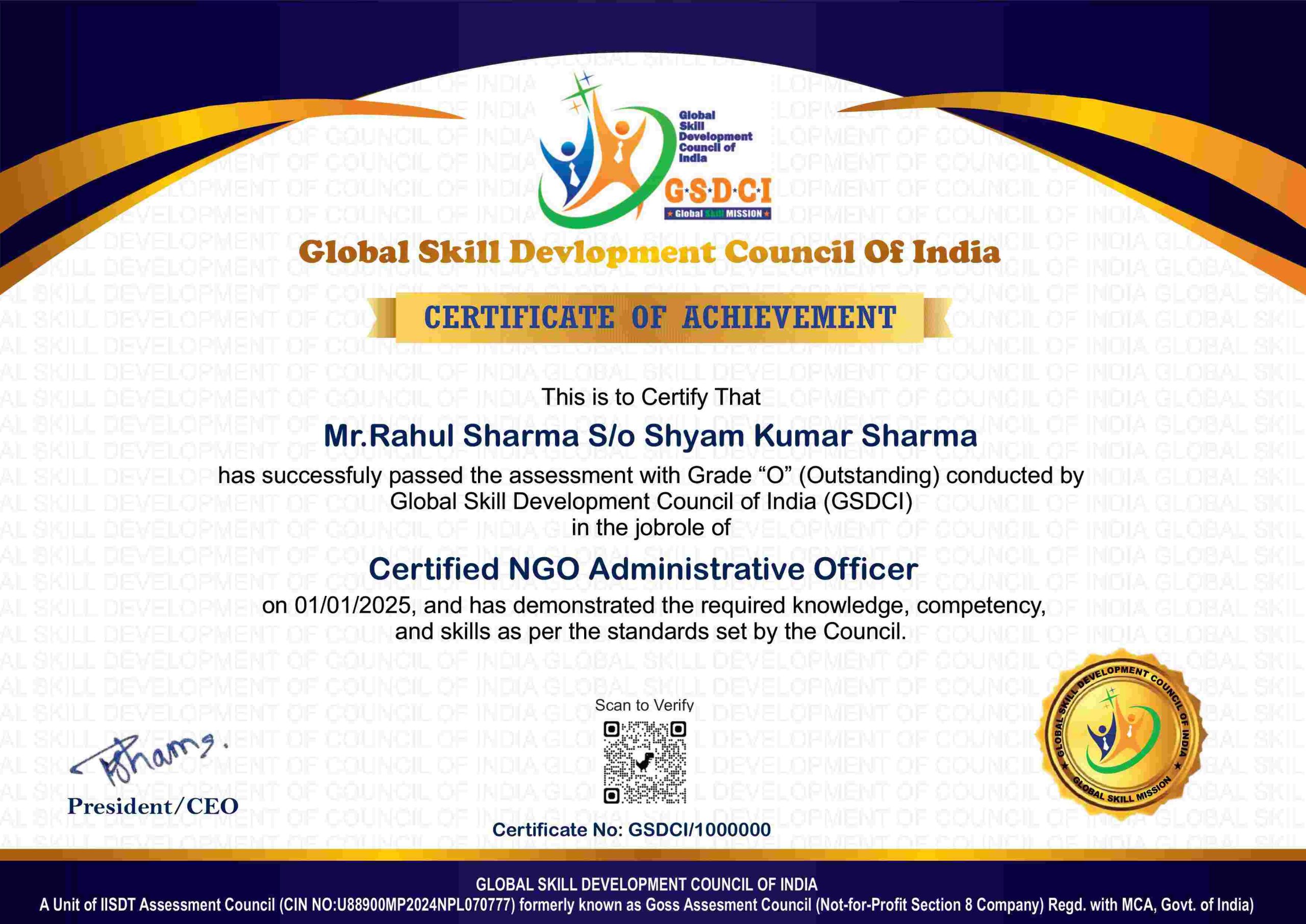
Step 6: After completion of online assessment, you can download your Certificate Immediately.
Assessment Modules:
Module 1: Introduction to Microeconomics: Definition and Scope of Microeconomics, Difference Between Micro and Macroeconomics, Basic Economic Problems and Solutions, Concepts of Scarcity and Opportunity Cost, Positive vs Normative Economics, Role of Microeconomics in Decision-Making.
Module 2: Demand, Supply and Market Equilibrium: Law of Demand and Determinants, Law of Supply and Determinants, Elasticity of Demand and Supply, Shifts vs Movements in Curves, Market Equilibrium and Price Determination, Impact of Government Intervention (Taxes, Price Controls).
Module 3: Consumer and Producer Behavior: Theory of Consumer Choice, Utility Analysis – Cardinal and Ordinal, Indifference Curve and Budget Line, Law of Diminishing Marginal Utility, Theory of Production – Short and Long Run, Law of Variable Proportions and Returns to Scale.
Module 4: Cost and Revenue Analysis: Types of Costs – Fixed, Variable, Total, Marginal, Average, Short-Run and Long-Run Cost Curves, Revenue Concepts – TR, AR, MR, Relationship Between Cost and Revenue, Profit Maximization, Break-even Analysis.
Module 5: Market Structures and Pricing: Perfect Competition – Features and Price Output Determination, Monopoly and Price Discrimination, Monopolistic Competition – Product Differentiation, Oligopoly – Kinked Demand Curve and Cartel Theory, Price and Output Determination under Each Market, Efficiency and Welfare Implications.
Module 6: Factor Pricing and Welfare Economics: Theories of Wages, Rent, Interest and Profit, Marginal Productivity Theory, Functional vs Personal Income Distribution, Market Failures and Externalities, Public Goods and Welfare Economics, Role of Government in Resource Allocation.
GSDCI Online Assessment Detail:
- Duration- 60 minutes.
- Number of Questions- 30.
- Number of Questions from each module: 5.
- Language: English.
- Exam Type: Multiple Choice Questions.
- Maximum Marks- 100, Passing Marks- 50%.
- There is no negative marking in any module.
| Marking System: | |||
| S.No. | No. of Questions | Marks Each Question | Total Marks |
| 1 | 10 | 5 | 50 |
| 2 | 5 | 4 | 20 |
| 3 | 5 | 3 | 15 |
| 4 | 5 | 2 | 10 |
| 5 | 5 | 1 | 5 |
| 30 | 100 | ||
| How Students will be Graded: | |||
| S.No. | Marks | Grade | |
| 1 | 91-100 | O (Outstanding) | |
| 2 | 81-90 | A+ (Excellent) | |
| 3 | 71-80 | A (Very Good) | |
| 4 | 61-70 | B (Good) | |
| 5 | 50-60 | P (Pass) | |
| 6 | 0-49 | F (Fail) | |
Benefits of Certification:
🌍 1. Global Recognition & Credibility – Stand out worldwide with a certification that opens doors across borders. Trusted by employers, respected by institutions, and recognized in over 100 countries.
📜 2. Quality Assurance through ISO Certification – Certified to global ISO standards, our programs deliver excellence, consistency, and a benchmarked learning experience that speaks for itself.
💼 3. Career Advancement & Employability – Enhances your resume and increases chances of promotions or job offers.
🤝 4. Non-Profit Trust Factor – Certifications from non-profit organizations are mission-driven rather than profit-driven.
📚 5. Access to Verified Learning & Resources – Often includes e-books, mock tests, and online support without hidden costs.
🔍 6. Transparency & Online Verification – Certifications come with a unique Enrolment ID for easy online verification by employers and institutions.
⏳ 7. Lifetime or Long-Term Validity – Certifications usually have lifetime validity or long-term recognition, reducing the need for frequent renewals.
Reviews
There are no reviews yet.