
No products in the cart.

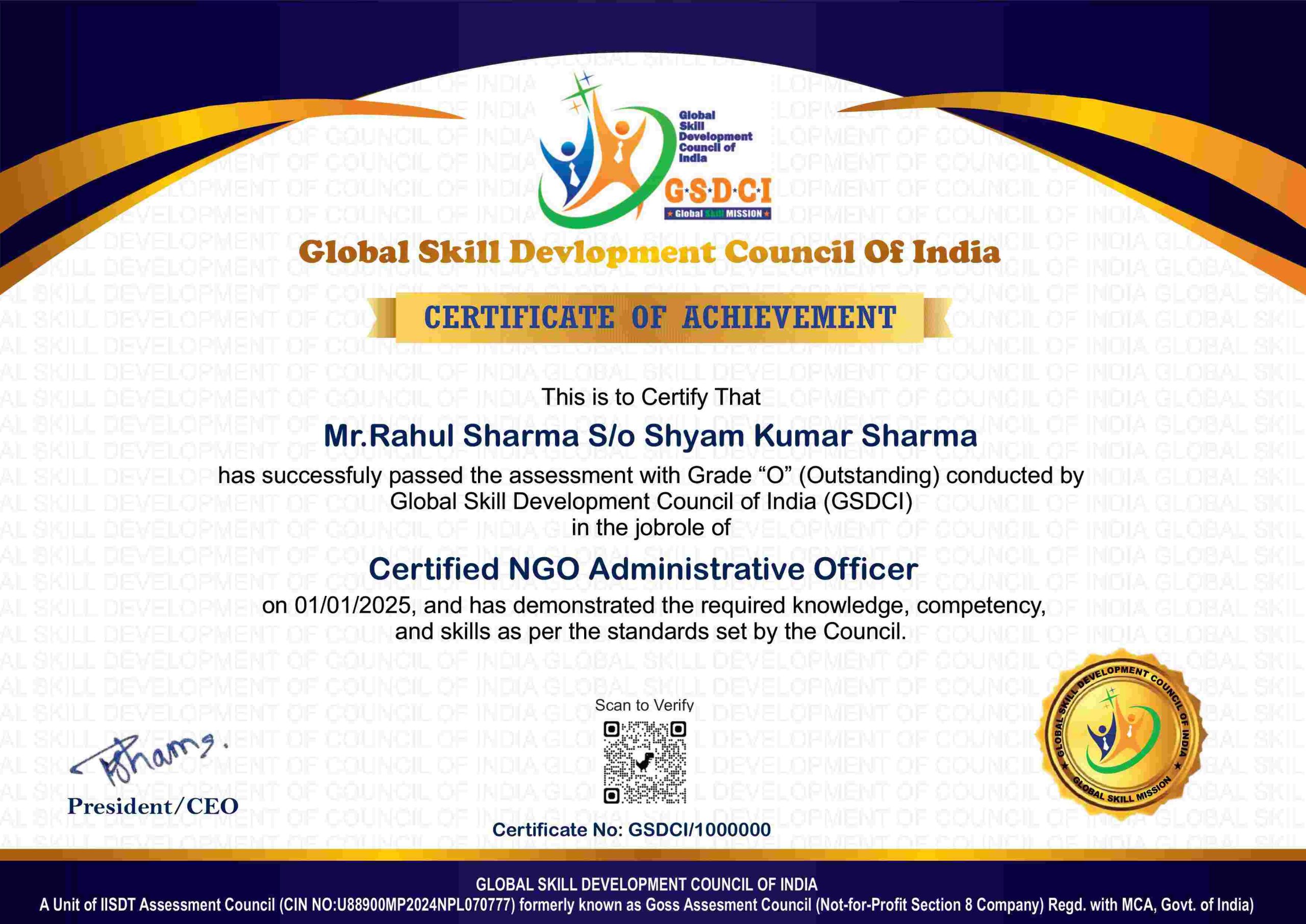

Certified Non-profit public relations & Advocacy Specialist
₹6,500.00 ₹3,250.00
50% fee concession will end in
To train learners in managing public relations and advocacy campaigns for non-profits to build visibility, trust, and policy influence for social causes.
Description
Certification Name: Certified Non-profit public relations & Advocacy Specialist
Global Occupational Skill Standard – GOSS ID: GOSS/JPM/CNPRAS/V1
Eligibility: Graduation or Equivalent or minimum 2 years of relevant experience (experience-based learners can directly enroll and certify).
Objective: The Certified Non-Profit Public Relations & Advocacy Specialist course is designed to prepare learners to effectively manage public communication and strategic advocacy for NGOs, charitable organizations, and social impact initiatives. The course covers key areas such as media outreach, campaign planning, storytelling for impact, donor and stakeholder communication, press release writing, event promotion, and managing social media for non-profits. It also emphasizes building relationships with journalists, influencers, policymakers, and the public.
Certification: Within 5 days after Completion of Online Assessment.
Get ready to join the Journey to become a GSDCI Certified Professional – International Certification and Assessment Body.
Steps to become a GSDCI Certified Professional:
Step 1: Select your certification you want to pursue.
Step 2: Click on get certified tab, new pop up window will open.
Step 3: Click on pay certification fee, you will be redirected to billing details page.
Step 4: Fill your details and click on pay certification fee, You will be redirected to payment gateway, pay fee by any available options like Card(Debit/Credit), Wallet, Paytm, Net banking, UPI and Google pay.
Step 5: You will get Login Credentials of Online E-Books and Online assessment link on your email id, within 48 hrs of payment.
Step 6: After completion of online assessment, you can download your Certificate Immediately.
Assessment Modules:
Module 1: Foundations of Non-Profit Public Relations and Advocacy: Understanding the mission-driven nature of non-profits and the role of PR, Differences between non-profit and corporate PR strategies, Key stakeholders in the non-profit ecosystem: donors, media, volunteers, beneficiaries, Role of advocacy in shaping policy, public opinion, and awareness, Integrating communication with fundraising, outreach, and program impact, Ethical considerations and credibility in non-profit messaging.
Module 2: Strategic Communication Planning for Non-Profits: Developing communication goals aligned with organizational mission and values, Crafting key messages and calls to action for diverse audiences, Segmenting stakeholders and tailoring outreach methods, Building media kits, press releases, and information packets, Planning annual PR calendars, campaigns, and advocacy milestones, Crisis communication planning and reputation risk assessment.
Module 3: Media Relations and Storytelling for Impact: Building relationships with journalists, bloggers, and local media, Pitching human-interest stories and program successes effectively, Writing persuasive op-eds, press releases, and newsletters, Leveraging storytelling to highlight community voices and outcomes, Organizing press conferences, field visits, and media coverage events, Creating visual and multimedia content to enhance narrative appeal.
Module 4: Digital Communication and Social Media Advocacy: Creating a digital media strategy across platforms (Facebook, Instagram, X/Twitter, LinkedIn), Developing campaign hashtags, toolkits, and shareable assets, Using content formats like videos, infographics, and livestreams for advocacy, Engaging online communities and building supporter momentum, Measuring engagement and impact through analytics tools, Managing online reputation, comments, and public feedback.
Module 5: Public Policy, Campaigning, and Stakeholder Engagement: Understanding the policy environment and role of lobbying in advocacy, Designing advocacy campaigns to influence decision-makers and the public, Engaging with policymakers, government bodies, and coalitions, Conducting public forums, signature drives, petitions, and awareness events, Grassroots organizing, volunteer mobilization, and capacity building, Monitoring and evaluating advocacy outcomes and stakeholder alignment.
Module 6: Fundraising PR, Reporting, and Career Readiness: Integrating PR with fundraising appeals, donor communications, and grant visibility, Communicating transparency, accountability, and program impact through reports, Building long-term relationships with institutional donors and philanthropic media, Developing a PR and advocacy portfolio with campaigns and case studies, Exploring roles in NGOs, INGOs, CSR teams, and policy think tanks, Staying current with trends in civic engagement, digital advocacy, and donor behavior.
GSDCI Online Assessment Detail:
- Duration- 60 minutes.
- Number of Questions- 30.
- Number of Questions from each module: 5.
- Language: English.
- Exam Type: Multiple Choice Questions.
- Maximum Marks- 100, Passing Marks- 50%.
- There is no negative marking in any module.
| Marking System: | |||
| S.No. | No. of Questions | Marks Each Question | Total Marks |
| 1 | 10 | 5 | 50 |
| 2 | 5 | 4 | 20 |
| 3 | 5 | 3 | 15 |
| 4 | 5 | 2 | 10 |
| 5 | 5 | 1 | 5 |
| 30 | 100 | ||
| How Students will be Graded: | |||
| S.No. | Marks | Grade | |
| 1 | 91-100 | O (Outstanding) | |
| 2 | 81-90 | A+ (Excellent) | |
| 3 | 71-80 | A (Very Good) | |
| 4 | 61-70 | B (Good) | |
| 5 | 50-60 | P (Pass) | |
| 6 | 0-49 | F (Fail) | |
Benefits of Certification:
🌍 1. Global Recognition & Credibility – Stand out worldwide with a certification that opens doors across borders. Trusted by employers, respected by institutions, and recognized in over 100 countries.
📜 2. Quality Assurance through ISO Certification – Certified to global ISO standards, our programs deliver excellence, consistency, and a benchmarked learning experience that speaks for itself.
💼 3. Career Advancement & Employability – Enhances your resume and increases chances of promotions or job offers.
🤝 4. Non-Profit Trust Factor – Certifications from non-profit organizations are mission-driven rather than profit-driven.
📚 5. Access to Verified Learning & Resources – Often includes e-books, mock tests, and online support without hidden costs.
🔍 6. Transparency & Online Verification – Certifications come with a unique Enrolment ID for easy online verification by employers and institutions.
⏳ 7. Lifetime or Long-Term Validity – Certifications usually have lifetime validity or long-term recognition, reducing the need for frequent renewals.
Reviews
There are no reviews yet.