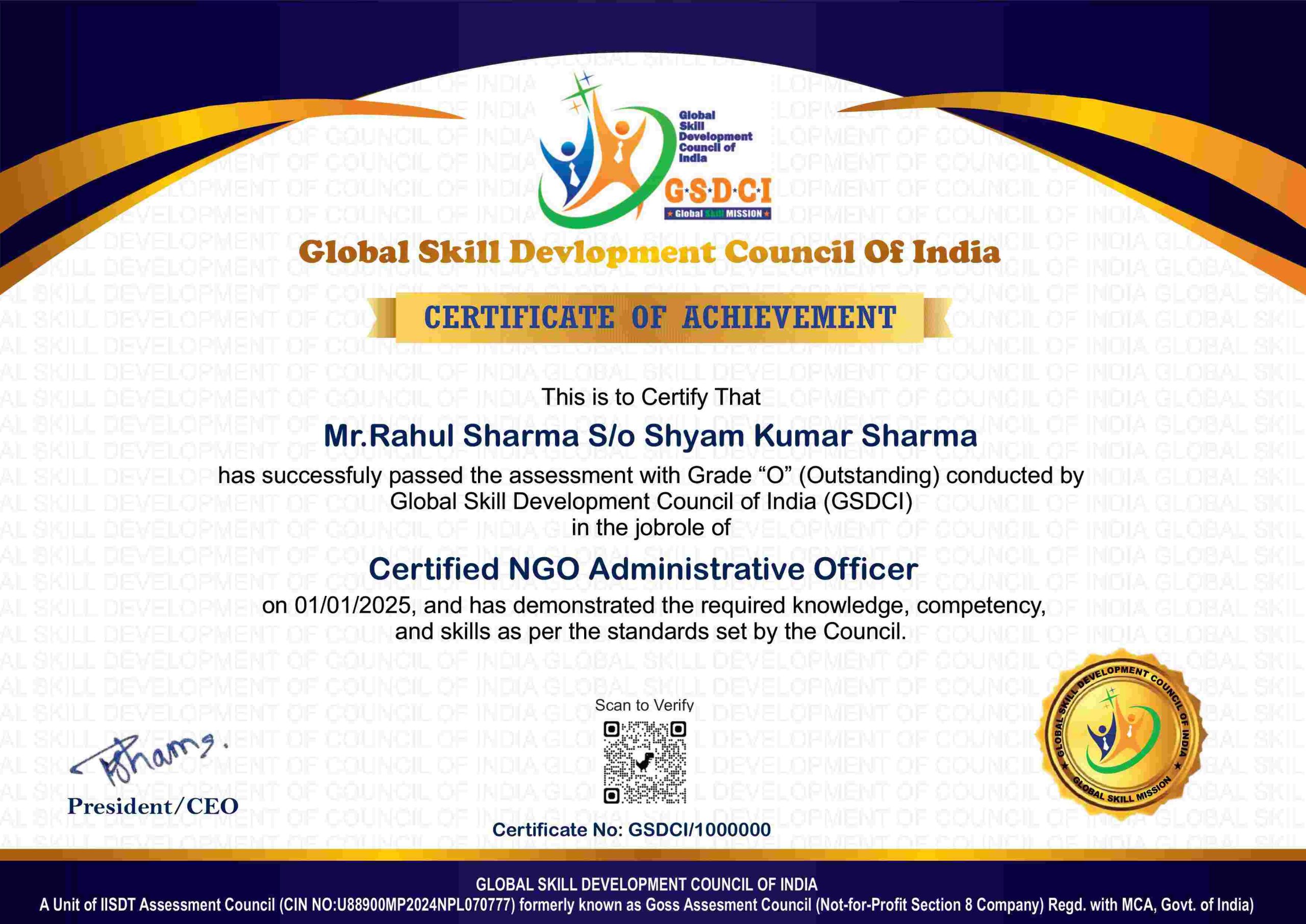
Certified Statistics Professional

6,500.00 3,250.00

50% fee concession will end in

This course aims to equip learners with foundational skills in data collection, descriptive and inferential statistics, probability distributions, and regression analysis. It covers time‐series forecasting, hypothesis testing, and the use of statistical software (Excel, SPSS, R/Python), preparing candidates for roles such as Data Analyst, Statistician, or Business Intelligence Specialist.

Description

Certification Name: Certified Statistics Professional

Global Occupational Skill Standard – GOSS ID: GOSS/BAF/CSP/V1

Eligibility: Graduation or Equivalent or minimum 2 years of relevant experience (experience-based learners can directly enroll and certify).

Objective: The Certified Statistics Professional course is designed to provide comprehensive knowledge of statistical concepts, tools, and applications in real-world decision-making. The course equips learners with data analysis techniques, probability theory, hypothesis testing, and statistical software proficiency to prepare for roles in analytics, research, quality control, and business intelligence.

Certification: Within 5 days after Completion of Online Assessment.

Get ready to join the Journey to become a GSDCI Certified Professional  – International Certification and Assessment Body.

Steps to become a GSDCI Certified Professional:

Step 1: Select your certification you want to pursue.

Step 2: Click on get certified tab, new pop up window will open.

Step 3: Click on pay certification fee, you will be redirected to billing details page.

Step 4: Fill your details and click on pay certification fee, You will be redirected to payment gateway, pay fee by any available options like Card(Debit/Credit), Wallet, Paytm, Net banking, UPI and Google pay.

Step 5: You will get Login Credentials of Online E-Books and Online assessment link on your email id, within 48 hrs of payment.

Step 6: After completion of online assessment, you can download your Certificate Immediately.

Assessment Modules:

Module 1: Introduction to Statistics: Definition and Scope of Statistics, Types of Data – Qualitative and Quantitative, Primary and Secondary Data Sources, Levels of Measurement – Nominal, Ordinal, Interval, Ratio, Importance and Limitations of Statistics, Applications in Business and Research.

Module 2: Data Collection and Presentation: Methods of Data Collection, Sampling Techniques and Errors, Frequency Distribution and Tabulation, Diagrammatic Presentation – Bar, Pie, Line Charts, Graphical Presentation – Histogram, Ogive, Frequency Polygon, Use of Excel/Software for Data Visualization.

Module 3: Measures of Central Tendency and Dispersion: Mean, Median, and Mode – Calculation and Comparison, Weighted Average and Combined Mean, Range, Quartile Deviation, Mean Deviation, Standard Deviation and Variance, Coefficient of Variation, Applications and Interpretation.

Module 4: Probability and Probability Distributions: Basic Probability Concepts and Rules, Conditional Probability and Bayes’ Theorem, Random Variables – Discrete and Continuous, Binomial and Poisson Distributions, Normal Distribution – Properties and Applications, Probability Distribution Curves and Fitting.

Module 5: Correlation, Regression and Time Series: Types and Measurement of Correlation, Karl Pearson and Spearman’s Rank Correlation, Linear Regression – Equation and Interpretation, Multiple Regression Basics, Time Series Components and Analysis, Trend Analysis and Forecasting Techniques.

Module 6: Statistical Inference and Hypothesis Testing: Population and Sample Concepts, Sampling Distribution and Central Limit Theorem, Hypothesis Formulation and Testing Procedure, t-test, z-test, Chi-square and ANOVA, Type I and Type II Errors, Interpretation of p-values and Confidence Intervals.

GSDCI Online Assessment Detail:

  • Duration- 60 minutes.
  • Number of Questions- 30.
  • Number of Questions from each module: 5.
  • Language: English.
  • Exam Type: Multiple Choice Questions.
  • Maximum Marks- 100, Passing Marks- 50%.
  • There is no negative marking in any module.
Marking System:
S.No. No. of Questions Marks Each Question Total Marks
1 10 5 50
2 5 4 20
3 5 3 15
4 5 2 10
5 5 1 5
30   100
How Students will be Graded:
S.No. Marks Grade
1 91-100 O (Outstanding)
2 81-90 A+ (Excellent)
3 71-80 A (Very Good)
4 61-70 B (Good)
5 50-60 P (Pass)
6  0-49 F (Fail)


Benefits of Certification:

🌍 1. Global Recognition & Credibility – Stand out worldwide with a certification that opens doors across borders. Trusted by employers, respected by institutions, and recognized in over 100 countries.

📜 2. Quality Assurance through ISO Certification – Certified to global ISO standards, our programs deliver excellence, consistency, and a benchmarked learning experience that speaks for itself.

💼 3. Career Advancement & Employability – Enhances your resume and increases chances of promotions or job offers.

🤝 4. Non-Profit Trust Factor – Certifications from non-profit organizations are mission-driven rather than profit-driven.

📚 5. Access to Verified Learning & Resources – Often includes e-books, mock tests, and online support without hidden costs.

🔍 6. Transparency & Online Verification – Certifications come with a unique Enrolment ID for easy online verification by employers and institutions.

⏳ 7. Lifetime or Long-Term Validity – Certifications usually have lifetime validity or long-term recognition, reducing the need for frequent renewals.