No products in the cart.


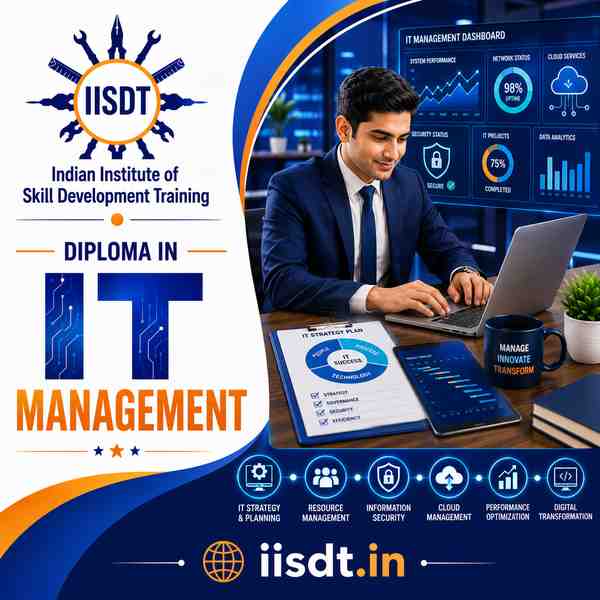
Diploma in IT Management
₹11,000.00 ₹5,500.00
50% fee concession will end in
A Diploma in IT Management is a specialized program designed to equip individuals with the skills and knowledge needed to effectively manage information technology (IT) resources, systems, and teams within an organization. This course focuses on the strategic, operational, and technical aspects of IT management, preparing students to handle the growing demand for IT professionals in a wide range of industries.
Description
Course Name: Diploma in IT Management
Course Id: DITM/Q1001.
Eligibility: Completion of 10+2 (higher Secondary) or equivalent.
Objective: A Diploma in IT Management is an excellent choice for individuals looking to pursue a career in IT leadership, combining technical knowledge with strategic business management. This course provides the tools to manage complex IT systems, teams, and projects, preparing graduates for a wide range of opportunities in the IT sector.
Duration: Six Months.
How to Enroll and Get Certified in Your Chosen Course:
Step 1: Choose the course you wish to get certified in.
Step 2: Click on the “Enroll Now” button.
Step 3: Proceed with the enrollment process.
Step 4: Enter your billing details and continue to course fee payment.
Step 5: You will be redirected to the payment gateway. Pay the course and exam fee using one of the following methods:
Debit/Credit Card, Wallet, Paytm, Net Banking, UPI, or Google Pay.
Step 6: After successful payment, you will receive your study material login ID and password via email within 48 hours of fee payment.
Step 7: Once you complete the course, take the online examination.
Step 8: Upon passing the examination, you will receive:
• A soft copy (scanned) of your certificate via email within 7 days of examination.
• A hard copy (original with official seal and signature) sent to your address within 45 day of declaration of result.
Step 9: After certification, you will be offered job opportunities aligned with your area of interest.
Online Examination Detail:
Duration- 120 minutes.
No. of Questions- 60. (Multiple Choice Questions).
10 Questions from each module, each carry 10 marks.
Maximum Marks- 600, Passing Marks- 40%.
There is no negative marking in this module.
| How Students will be Graded: | ||
| S.No. | Marks | Grade |
| 1 | 91-100 | O (Outstanding) |
| 2 | 81-90 | A+ (Excellent) |
| 3 | 71-80 | A (Very Good) |
| 4 | 61-70 | B (Good) |
| 5 | 51-60 | C (Average) |
| 6 | 41-50 | P (Pass) |
| 7 | 0-40 | F (Fail) |
Key Benefits of Certification- Earning a professional certification not only validates your skills but also enhances your employability. Here are the major benefits you gain:
Practical, Job-Ready Skills – Our certifications are designed to equip you with real-world, hands-on skills that match current industry demands — helping you become employment-ready from day one.
Lifetime Validity – Your certification is valid for a lifetime — no renewals or expirations. It serves as a permanent proof of your skills and training.
Lifetime Certificate Verification – Employers and institutions can verify your certification anytime through a secure and reliable verification system — adding credibility to your qualifications.
Industry-Aligned Certification –All certifications are developed in consultation with industry experts to ensure that what you learn is current, relevant, and aligned with market needs.
Preferred by Employers – Candidates from ISO-certified institutes are often prioritized by recruiters due to their exposure to standardized, high-quality training.
Free Job Assistance Based on Your Career Interests – Receive personalized job assistance and career guidance in your preferred domain, helping you land the right role faster.
Syllabus
Fundamentals of IT Management: Introduction to IT Management, Role of IT in Business, IT Governance and Compliance, IT Infrastructure Overview, Digital Transformation Strategies, Data Management and Security, IT Service Management (ITSM), Cloud Computing Basics, Emerging Technologies in IT, IT Policies and Best Practices.
IT Project Management: Introduction to Project Management, Project Lifecycle and Methodologies (Waterfall, Agile, Scrum), IT Budgeting and Cost Control, Risk Management in IT Projects, Resource Allocation and Scheduling, Stakeholder Communication and Management, IT Procurement and Vendor Management, Change Management in IT, Project Monitoring and Evaluation, Case Studies in IT Project Management.
IT Infrastructure and Networking: Overview of IT Infrastructure, Network Topologies and Protocols, Server Management and Virtualization, Data Centers and Cloud Computing, Network Security and Firewalls, IT Disaster Recovery Planning, Internet of Things (IoT) in IT Infrastructure, Remote Work and IT Infrastructure, IT Asset Management, IT Performance Monitoring Tools.
Cybersecurity and Risk Management: Introduction to Cybersecurity, Types of Cyber Threats (Malware, Phishing, Ransomware), IT Risk Assessment and Management, Data Encryption and Protection, Compliance Standards (ISO 27001, GDPR), Identity and Access Management (IAM), Incident Response Planning, Security Auditing and Testing, Ethical Hacking Basics, Best Practices in IT Security.
Cloud Computing and Virtualization: Introduction to Cloud Computing, Cloud Service Models (IaaS, PaaS, SaaS), Virtualization Technologies, Cloud Security and Compliance, Cloud Deployment Models (Public, Private, Hybrid), Cost Optimization in Cloud Computing, IT Automation and Orchestration, Containerization (Docker, Kubernetes), Cloud-Based Backup and Disaster Recovery, Future Trends in Cloud Computing.
Enterprise Software and Database Management: Enterprise Resource Planning (ERP) Systems, Database Management Systems (DBMS), SQL and NoSQL Databases, Data Warehousing and Business Intelligence, CRM and HRM Software, IT Asset Management Software, Database Security and Backup Strategies, Data Analytics for IT Decision Making, AI and Machine Learning in IT Management.
Job Opportunities after Diploma in IT Management
Graduates can build careers in managing IT operations, technology strategy, and digital infrastructure across industries such as IT services, consulting, software development, cybersecurity, and corporate technology departments.
Top Roles: IT Manager, IT Project Manager, System Administrator, Network Administrator, IT Consultant, Database Administrator (DBA), Software Development Manager, Business Analyst (IT), Cybersecurity Analyst, Cloud Solutions Architect, IT Support Specialist, IT Infrastructure Manager
Key Sectors: IT services and consulting, software and application development, corporate IT departments, cybersecurity firms, cloud service providers, e-commerce and technology-driven companies
Salary Range (India):
- Entry-level: ₹3–5 LPA
- Mid-level: ₹6–10 LPA
- Senior-level: ₹12–20+ LPA (varies by role, experience, and organization)
Scope: With the rapid digitization of businesses and growing reliance on IT systems, skilled IT management professionals are highly sought after. Graduates can advance into senior roles like IT Manager, Cloud Solutions Architect, or Software Development Manager, making this a promising career path with strong growth, high earning potential, and opportunities across multiple industries.