No products in the cart.


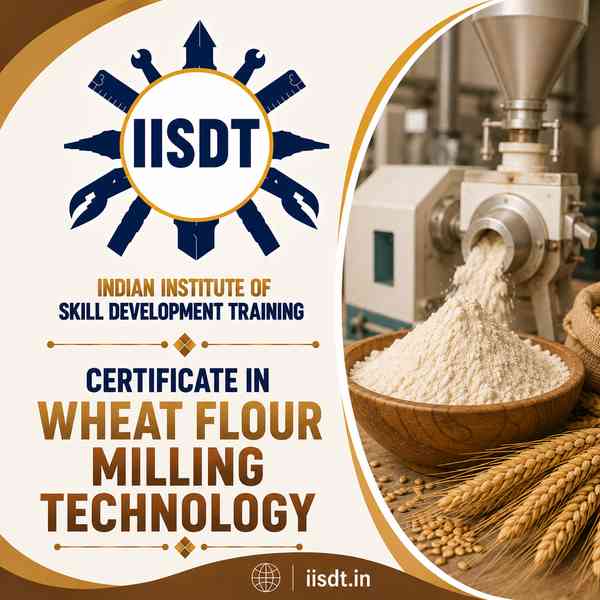
Certificate in Wheat Flour Milling Technology
₹6,500.00 ₹3,250.00
50% fee concession will end in
The course is designed to develop knowledge of wheat flour milling, processing techniques, quality control, packaging, and business management for profitable operations.
Description
Course Name: Certificate in Wheat Flour Milling Technology
Course Id: CWFMT/Q1001.
Eligibility: 10th Grade(High School) or Equivalent.
Duration: One Month.
Objective: The course aims to provide learners with comprehensive knowledge of wheat flour milling technology. It covers wheat selection, cleaning, conditioning, milling processes, and quality control to produce high-grade flour. Participants will also learn about machinery operation, storage, packaging, hygiene standards, and compliance with food safety regulations.
How to Enroll and Get Certified in Your Chosen Course:
Step 1: Choose the course you wish to get certified in.
Step 2: Click on the “Enroll Now” button.
Step 3: Proceed with the enrollment process.
Step 4: Enter your billing details and continue to course fee payment.
Step 5: You will be redirected to the payment gateway. Pay the course and exam fee using one of the following methods:
Debit/Credit Card, Wallet, Paytm, Net Banking, UPI, or Google Pay.
Step 6: After successful payment, you will receive your study material login ID and password via email within 48 hours of fee payment.
Step 7: Once you complete the course, take the online examination.
Step 8: Upon passing the examination, you will receive:
• A soft copy (scanned) of your certificate via email within 7 days of examination.
• A hard copy (original with official seal and signature) sent to your address within 45 day of declaration of result.
Step 9: After certification, you will be offered job opportunities aligned with your area of interest.
Online Examination Detail:
Duration- 60 minutes.
No. of Questions- 30. (Multiple Choice Questions).
Maximum Marks- 100, Passing Marks- 40%.
There is no negative marking in this module.
| Marking System: | ||||||
| S.No. | No. of Questions | Marks Each Question | Total Marks | |||
| 1 | 10 | 5 | 50 | |||
| 2 | 5 | 4 | 20 | |||
| 3 | 5 | 3 | 15 | |||
| 4 | 5 | 2 | 10 | |||
| 5 | 5 | 1 | 5 | |||
| 30 | 100 | |||||
| How Students will be Graded: | ||||||
| S.No. | Marks | Grade | ||||
| 1 | 91-100 | O (Outstanding) | ||||
| 2 | 81-90 | A+ (Excellent) | ||||
| 3 | 71-80 | A (Very Good) | ||||
| 4 | 61-70 | B (Good) | ||||
| 5 | 51-60 | C (Average) | ||||
| 6 | 40-50 | P (Pass) | ||||
| 7 | 0-40 | F (Fail) | ||||
Key Benefits of Certification- Earning a professional certification not only validates your skills but also enhances your employability. Here are the major benefits you gain:
Practical, Job-Ready Skills – Our certifications are designed to equip you with real-world, hands-on skills that match current industry demands — helping you become employment-ready from day one.
Lifetime Validity – Your certification is valid for a lifetime — no renewals or expirations. It serves as a permanent proof of your skills and training.
Lifetime Certificate Verification – Employers and institutions can verify your certification anytime through a secure and reliable verification system — adding credibility to your qualifications.
Industry-Aligned Certification –All certifications are developed in consultation with industry experts to ensure that what you learn is current, relevant, and aligned with market needs.
Preferred by Employers – Candidates from ISO-certified institutes are often prioritized by recruiters due to their exposure to standardized, high-quality training.
Free Job Assistance Based on Your Career Interests – Receive personalized job assistance and career guidance in your preferred domain, helping you land the right role faster.
Syllabus
Introduction to Wheat and Milling Industry: History of wheat milling, Importance of wheat flour in food industry, Overview of global and local milling industries, Types of wheat and their uses, Market demand for wheat flour, Nutritional aspects of wheat flour, Milling industry standards and regulations, Trends and innovations in milling, Role of wheat in food security, Career scope in flour milling.
Wheat Grain Structure and Varieties: Anatomy of wheat grain (bran, germ, endosperm), Hard vs. soft wheat, Durum wheat characteristics, Protein and gluten content, Factors affecting wheat quality, Wheat grading systems, Seasonal and regional wheat varieties, Wheat storage practices, Moisture and impurity levels, Wheat selection for different products.
Milling Equipment and Machinery: Cleaning equipment (scourers, separators), Conditioning and tempering tanks, Roller mills and break systems, Purifiers and sifters, Bran finishers and detachers, Pneumatic conveying systems, Packaged flour weighing machines, Maintenance of milling equipment, Automation in milling technology, Safety practices in machinery use.
Cleaning and Conditioning of Wheat: Types of impurities in wheat, Screening and aspirating processes, Destoning and magnetic separation, Scouring and washing, Drying and moisture adjustment, Conditioning process overview, Storage after conditioning, Effect of cleaning on flour quality, Water addition techniques, Equipment used in cleaning section.
Milling Process and Techniques: Break and reduction systems, Gradual reduction principle, Sifting and classification, Rebolting and flour extraction, Impact on flour yield and quality, Managing ash content, Regrinding and bran separation, By-product utilization (bran, germ), Flow chart of milling process, Troubleshooting in milling.
Quality Control and Testing: Sampling of wheat and flour, Moisture content determination, Gluten content and strength, Falling number and enzyme activity, Ash content analysis, Flour color and granulation, Baking test procedures, Laboratory equipment in milling, Compliance with FSSAI and BIS standards, Record keeping and reporting.