No products in the cart.


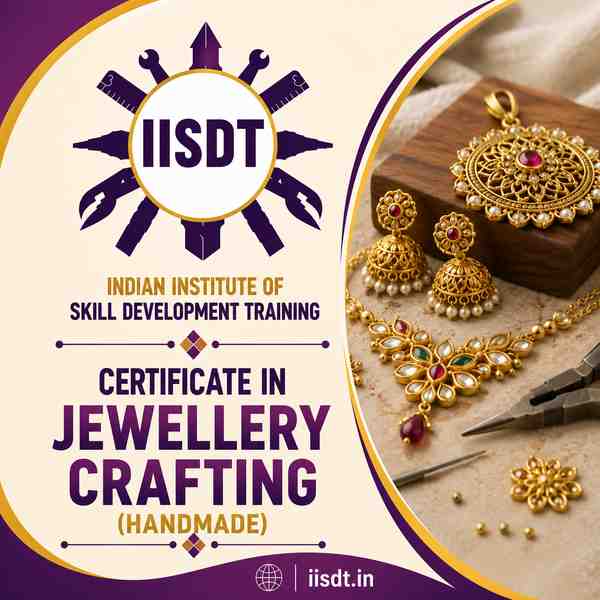
Certificate in Jewellery Crafting (Handmade)
₹6,500.00 ₹3,250.00
50% fee concession will end in
To equip learners with skills and creativity to design and craft unique handmade jewelry pieces.
Description
Course Name: Certificate in Jewellery Crafting (Handmade)
Course Id: CJC/Q1001.
Eligibility: 10th Grade(High School) or Equivalent.
Duration: One Month.
Objective: The objective of this course is to equip learners with the artistic skills, technical knowledge, and entrepreneurial mindset required to design and produce handmade jewellery. The course focuses on crafting techniques, material selection, design innovation, finishing processes, and small business development, empowering participants to create unique jewellery pieces and explore opportunities in the fashion and artisan markets.
How to Enroll and Get Certified in Your Chosen Course:
Step 1: Choose the course you wish to get certified in.
Step 2: Click on the “Enroll Now” button.
Step 3: Proceed with the enrollment process.
Step 4: Enter your billing details and continue to course fee payment.
Step 5: You will be redirected to the payment gateway. Pay the course and exam fee using one of the following methods:
Debit/Credit Card, Wallet, Paytm, Net Banking, UPI, or Google Pay.
Step 6: After successful payment, you will receive your study material login ID and password via email within 48 hours of fee payment.
Step 7: Once you complete the course, take the online examination.
Step 8: Upon passing the examination, you will receive:
• A soft copy (scanned) of your certificate via email within 7 days of examination.
• A hard copy (original with official seal and signature) sent to your address within 45 day of declaration of result.
Step 9: After certification, you will be offered job opportunities aligned with your area of interest.
Online Examination Detail:
Duration- 60 minutes.
No. of Questions- 30. (Multiple Choice Questions).
Maximum Marks- 100, Passing Marks- 40%.
There is no negative marking in this module.
| Marking System: | ||||||
| S.No. | No. of Questions | Marks Each Question | Total Marks | |||
| 1 | 10 | 5 | 50 | |||
| 2 | 5 | 4 | 20 | |||
| 3 | 5 | 3 | 15 | |||
| 4 | 5 | 2 | 10 | |||
| 5 | 5 | 1 | 5 | |||
| 30 | 100 | |||||
| How Students will be Graded: | ||||||
| S.No. | Marks | Grade | ||||
| 1 | 91-100 | O (Outstanding) | ||||
| 2 | 81-90 | A+ (Excellent) | ||||
| 3 | 71-80 | A (Very Good) | ||||
| 4 | 61-70 | B (Good) | ||||
| 5 | 51-60 | C (Average) | ||||
| 6 | 40-50 | P (Pass) | ||||
| 7 | 0-40 | F (Fail) | ||||
Key Benefits of Certification- Earning a professional certification not only validates your skills but also enhances your employability. Here are the major benefits you gain:
Practical, Job-Ready Skills – Our certifications are designed to equip you with real-world, hands-on skills that match current industry demands — helping you become employment-ready from day one.
Lifetime Validity – Your certification is valid for a lifetime — no renewals or expirations. It serves as a permanent proof of your skills and training.
Lifetime Certificate Verification – Employers and institutions can verify your certification anytime through a secure and reliable verification system — adding credibility to your qualifications.
Industry-Aligned Certification –All certifications are developed in consultation with industry experts to ensure that what you learn is current, relevant, and aligned with market needs.
Preferred by Employers – Candidates from ISO-certified institutes are often prioritized by recruiters due to their exposure to standardized, high-quality training.
Free Job Assistance Based on Your Career Interests – Receive personalized job assistance and career guidance in your preferred domain, helping you land the right role faster.
Syllabus
Introduction to Handmade Jewelry: History and evolution of jewelry, Types of handmade jewelry, Overview of jewelry materials, Importance of craftsmanship, Tools used in jewelry making, Understanding basic jewelry components, Role of culture in jewelry design, Introduction to jewelry trends, Safety practices in jewelry making, Career opportunities in jewelry crafting.
Materials and Tools: Types of beads and stones, Wires and threads for crafting, Clasps, hooks and fasteners, Metals used in handmade jewelry, Adhesives and pliers, Needle and stringing tools, Polishing tools and cleaning agents, Recycled and eco-friendly materials, Sourcing quality materials, Tool maintenance and storage.
Designing Techniques: Jewelry design basics, Color theory and combinations, Sketching jewelry designs, Pattern creation and repetition, Cultural and modern design fusion, Designing for different occasions, Creating mood boards, Digital jewelry design tools, Trend forecasting, Design portfolio development.
Beading and Stringing: Types of beading techniques, Single and multiple strand stringing, Knotting methods, Wire wrapping basics, Seed beading, Loom beading, Incorporating pendants and charms, Using beading needles, Stringing materials selection, Finishing techniques for beaded pieces.
Metal Jewelry Making: Types of crafting metals, Cutting and shaping metal, Hammering and texturing techniques, Soldering basics, Creating wire jewelry, Polishing and finishing metal jewelry, Making jump rings and connectors, Patina and coloring methods, Safety precautions with metals, Metal stamping.
Resin and Clay Jewelry: Introduction to resin jewelry, Mixing and pouring resin, Embedding objects in resin, Polymer clay basics, Clay molding and baking, Using molds and cutters, Sanding and polishing resin and clay, Color mixing for clay, Layering and finishing, Safety while working with chemicals.