No products in the cart.


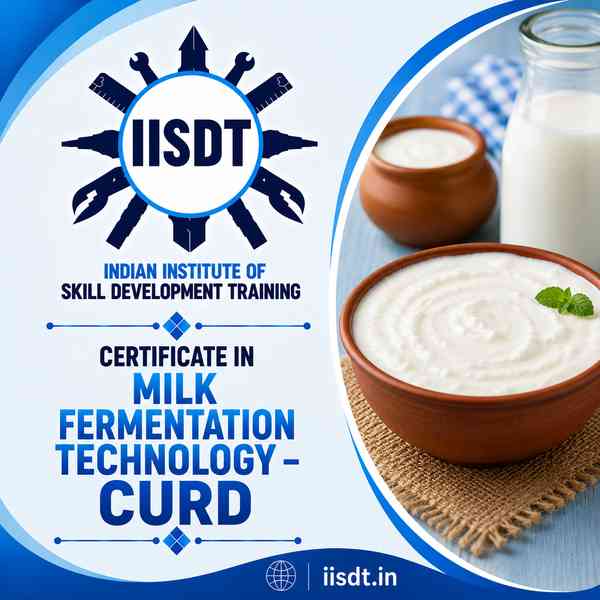
Certificate in Milk Fermentation Technology – CURD
₹6,500.00 ₹3,250.00
50% fee concession will end in
The course is designed to develop knowledge of milk fermentation processes for curd production, covering microbial cultures, quality control, processing, and commercial applications.
Description
Course Name: Certificate in Milk Fermentation Technology – CURD
Course Id: CMFT/Q1001.
Eligibility: 10th Grade(High School) or Equivalent.
Duration: One Month.
Objective: The course aims to provide learners with in-depth knowledge of milk fermentation technology with a focus on curd production. It introduces the science of fermentation, microbial cultures, and the biochemical processes that transform milk into curd.
How to Enroll and Get Certified in Your Chosen Course:
Step 1: Choose the course you wish to get certified in.
Step 2: Click on the “Enroll Now” button.
Step 3: Proceed with the enrollment process.
Step 4: Enter your billing details and continue to course fee payment.
Step 5: You will be redirected to the payment gateway. Pay the course and exam fee using one of the following methods:
Debit/Credit Card, Wallet, Paytm, Net Banking, UPI, or Google Pay.
Step 6: After successful payment, you will receive your study material login ID and password via email within 48 hours of fee payment.
Step 7: Once you complete the course, take the online examination.
Step 8: Upon passing the examination, you will receive:
• A soft copy (scanned) of your certificate via email within 7 days of examination.
• A hard copy (original with official seal and signature) sent to your address within 45 day of declaration of result.
Step 9: After certification, you will be offered job opportunities aligned with your area of interest.
Online Examination Detail:
Duration- 60 minutes.
No. of Questions- 30. (Multiple Choice Questions).
Maximum Marks- 100, Passing Marks- 40%.
There is no negative marking in this module.
| Marking System: | ||||||
| S.No. | No. of Questions | Marks Each Question | Total Marks | |||
| 1 | 10 | 5 | 50 | |||
| 2 | 5 | 4 | 20 | |||
| 3 | 5 | 3 | 15 | |||
| 4 | 5 | 2 | 10 | |||
| 5 | 5 | 1 | 5 | |||
| 30 | 100 | |||||
| How Students will be Graded: | ||||||
| S.No. | Marks | Grade | ||||
| 1 | 91-100 | O (Outstanding) | ||||
| 2 | 81-90 | A+ (Excellent) | ||||
| 3 | 71-80 | A (Very Good) | ||||
| 4 | 61-70 | B (Good) | ||||
| 5 | 51-60 | C (Average) | ||||
| 6 | 40-50 | P (Pass) | ||||
| 7 | 0-40 | F (Fail) | ||||
Key Benefits of Certification- Earning a professional certification not only validates your skills but also enhances your employability. Here are the major benefits you gain:
Practical, Job-Ready Skills – Our certifications are designed to equip you with real-world, hands-on skills that match current industry demands — helping you become employment-ready from day one.
Lifetime Validity – Your certification is valid for a lifetime — no renewals or expirations. It serves as a permanent proof of your skills and training.
Lifetime Certificate Verification – Employers and institutions can verify your certification anytime through a secure and reliable verification system — adding credibility to your qualifications.
Industry-Aligned Certification –All certifications are developed in consultation with industry experts to ensure that what you learn is current, relevant, and aligned with market needs.
Preferred by Employers – Candidates from ISO-certified institutes are often prioritized by recruiters due to their exposure to standardized, high-quality training.
Free Job Assistance Based on Your Career Interests – Receive personalized job assistance and career guidance in your preferred domain, helping you land the right role faster.
Syllabus
Introduction to Milk Fermentation: Definition and significance of fermentation, Historical development of fermented dairy products, Types of milk fermentation, Benefits of fermented dairy in human health, Role of curd in traditional diets, Microorganisms used in milk fermentation, Difference between curd, yogurt, and other cultured products, Overview of fermentation industries, Market potential for curd products, Regulatory and food safety concerns.
Milk Composition and Selection: Types of milk used for curd (cow, buffalo, goat), Milk constituents (fat, protein, lactose, minerals), Factors affecting milk quality, Seasonal variations in milk for fermentation, Effects of milk source on texture and flavor of curd, Standardization of milk for fermentation, Importance of fresh and clean milk, Milk testing techniques (lactometer, acidity, SNF), Storage and preservation of raw milk, Pre-treatment of milk before fermentation.
Starter Cultures and Microbiology: Definition and types of starter cultures, Common curd-forming bacteria (Lactobacillus, Streptococcus), Culture preparation and maintenance, Inoculation methods and dosage, Factors affecting bacterial growth (pH, temp, time), Characteristics of good starter cultures, Contamination prevention and hygiene, Culturing equipment and sterilization, Impact of culture on flavor and texture, Shelf life and storage of starter cultures.
Curd Processing Techniques: Milk heating and cooling methods, Standardization and homogenization steps, Culture inoculation procedure, Fermentation time and temperature settings, Curd setting vessels and environment, Influence of container material on curd quality, Texture improvement techniques, Avoiding whey separation, Setting curd in large and small batches, Influence of altitude and climate on fermentation.
Equipment Used in Curd Processing: Milk pasteurizers and boilers, Fermentation tanks and curd setting trays, Culture storage and inoculation tools, Temperature control devices, Cooling and refrigeration units, Utensils for mixing and transferring, Hygienic packaging tools, Equipment cleaning and maintenance, Automation in curd processing units, Cost-effective equipment for small businesses.
Hygiene, Sanitation, and Food Safety: Cleaning-in-place (CIP) practices, Sanitation of tools and fermentation area, Personal hygiene for handlers, Use of food-grade materials, Avoiding contamination and spoilage, HACCP principles in curd making, FSSAI standards for curd, Documentation and traceability practices, Allergen management in dairy units, Waste disposal and management.